
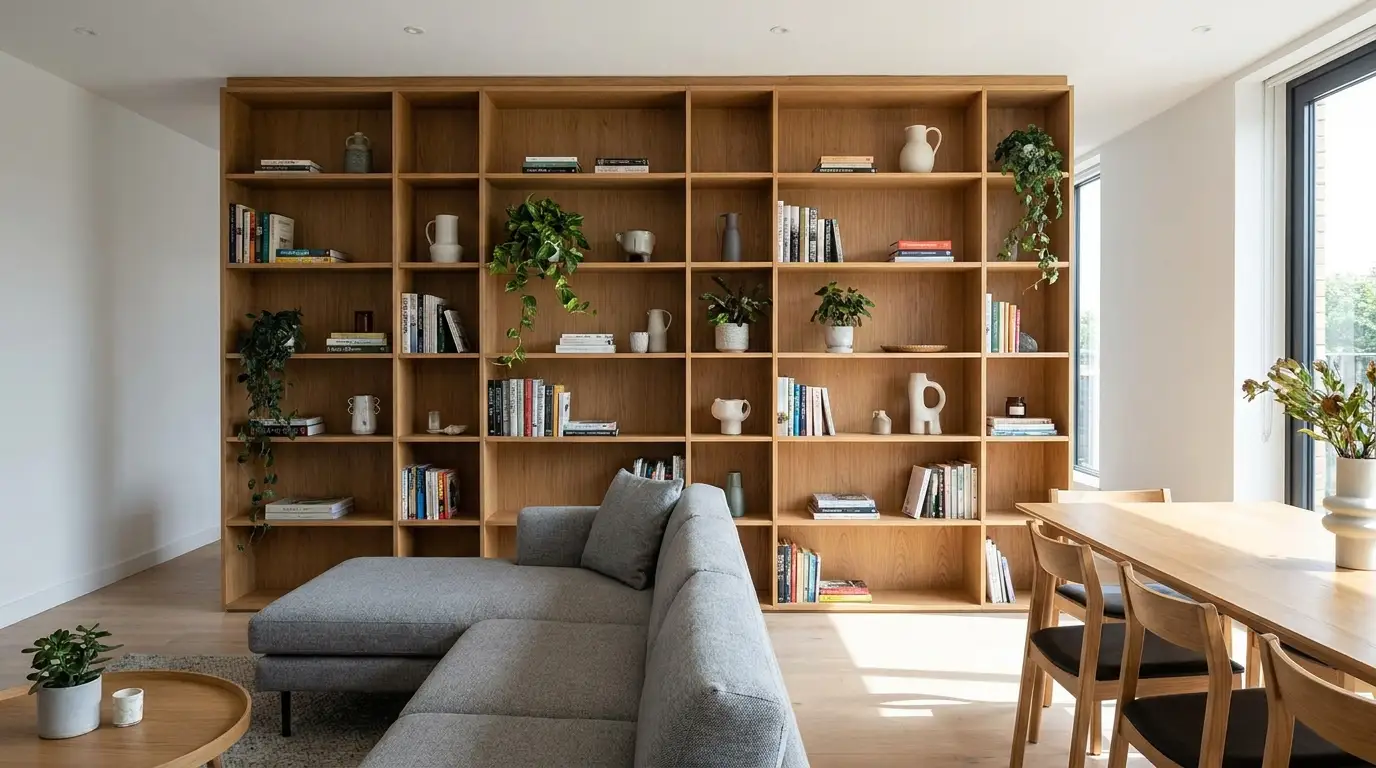

A room divider can change the way a space feels without the cost, permanence, or visual weight of a traditional wall. Among the most practical options, bookshelf room dividers stand out because they do two jobs at once: they separate areas while adding valuable storage and display space.
Whether you’re creating a home office in the living room, defining a bedroom in a studio apartment, separating a dining area from a lounge, or simply making an open-plan space feel more organized, a bookshelf can create a clear boundary without completely closing off the room.
The best bookshelf room dividers aren’t simply placed in the middle of a room. Their size, orientation, openness, storage capacity, lighting, and relationship with surrounding furniture all affect how well they work.
This guide explains how to choose and style a bookshelf room divider, including open shelving, double-sided bookcases, tall units, low shelves, built-ins, and creative solutions for small spaces.
Table of Contents
What Is a Bookshelf Room Divider?
A bookshelf room divider is a freestanding or built-in shelving unit positioned between two areas to visually separate them while providing storage or display space. Unlike a solid partition, an open bookshelf can maintain light flow and a sense of connection between spaces.
It can be used to:
- Separate a living room from a dining area
- Create a home office zone
- Divide a studio apartment into functional areas
- Define a sleeping area
- Separate an entryway from the main living space
- Create a reading nook
- Add storage to an open-plan room
- Visually organize a large room
The key advantage is flexibility. A bookshelf divider can establish boundaries without requiring construction.
Why Use a Bookshelf as a Room Divider?
Traditional walls provide privacy, but they also permanently change the architecture of a room. A bookshelf offers a middle ground between completely open space and a fully enclosed room.
1. You Get Storage and Separation
The biggest benefit is efficiency. Instead of adding a decorative partition that occupies floor space without providing a practical function, a bookshelf gives you shelves for books, baskets, plants, artwork, and everyday objects.
This is particularly useful in smaller homes where every square foot matters.
2. Light Can Still Pass Through
Open shelving creates visual separation without necessarily blocking natural light.
For example, an open bookcase positioned between a living room and dining area can distinguish the two zones while allowing the spaces to remain visually connected.
3. It Makes Open-Plan Rooms Feel More Organized
Large open rooms can sometimes feel undefined. Furniture may appear scattered because there are no obvious boundaries between activities.
A bookshelf can act as an architectural anchor, giving each area a clear purpose.
4. It Can Be More Flexible Than a Wall
A freestanding bookshelf can potentially be repositioned when your needs change. This makes it especially useful for renters, multipurpose rooms, and evolving home offices.
5. It Adds Personality
A room divider doesn’t have to look purely functional. Books, ceramics, framed art, plants, lighting, and collected objects can turn the shelving into a major decorative feature.
Design tip: Think of a bookshelf divider as a piece of architecture and furniture at the same time. Its job is not only to store things but also to shape how you experience the room.
The Best Types of Bookshelf Room Dividers
Not every bookshelf works equally well as a room divider. The right style depends on the room size, desired privacy, storage requirements, and amount of natural light.
| Bookshelf Type | Best For | Privacy | Light Flow | Storage |
|---|---|---|---|---|
| Open cube shelf | Small spaces, casual zoning | Low | Excellent | High |
| Double-sided bookcase | Living rooms, offices | Medium | Good | Excellent |
| Tall open shelving | Large rooms | Medium | Good | Excellent |
| Low bookshelf | Small rooms, sightline preservation | Low | Excellent | Moderate |
| Closed bookcase | More privacy | High | Low | Excellent |
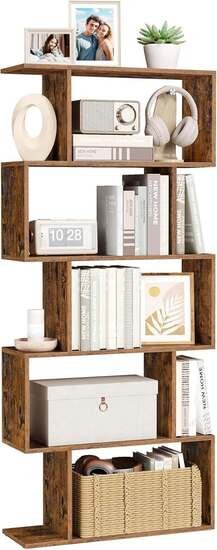
| Ladder shelf | Lightweight zoning | Low | Excellent | Moderate |
| Built-in shelving | Permanent layouts | Medium–High | Depends on design | Excellent |
1. Open Cube Bookshelf Room Dividers
Cube shelving is one of the easiest options for dividing a room.
Its grid-like structure creates individual compartments that can hold books, baskets, plants, artwork, and decorative objects. Because the openings remain visible, the unit separates spaces without creating a solid visual barrier.
Open cube shelving works especially well in:
- Studio apartments
- Children’s rooms
- Home offices
- Living rooms
- Creative workspaces
- Small bedrooms
For a sophisticated look, avoid filling every compartment. Empty spaces create visual breathing room.
How to Style Cube Shelving
Try alternating:
- Books
- Decorative boxes
- Small plants
- Sculptural objects
- Framed photographs
- Ceramic pieces
Keep some compartments completely empty to maintain an open appearance.
2. Double-Sided Bookshelf Dividers
A double-sided bookcase is one of the most effective options when both sides of the divider are visible.
Instead of having a finished decorative side and an unattractive back, a double-sided unit allows both areas to benefit from the shelving.
For example, one side could face a living room and hold books and decorative objects, while the other side could face a home office and contain work supplies, files, and baskets.
This creates two useful zones from one piece of furniture.
3. Tall Bookshelf Room Dividers
Tall shelving creates a stronger sense of separation than low shelving.
It’s particularly effective when you want to distinguish:
- A bedroom from a living area
- A workspace from a lounge
- A dining room from a living room
- A dressing area from a sleeping area
However, height changes the visual weight of the room.
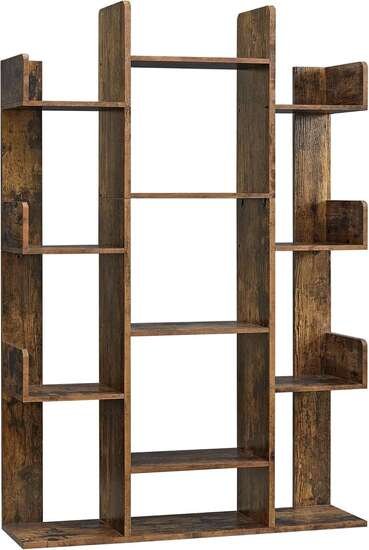
A solid, floor-to-ceiling bookcase can make a space feel much more enclosed. An open-backed design usually provides a better balance when maintaining light and visual connection is important.
4. Low Bookshelf Room Dividers
Low bookshelves are ideal when you want subtle zoning rather than complete separation.
A waist-height or similarly low unit can define a living room from a dining area while preserving sightlines across the room.
This approach works particularly well in smaller spaces because the ceiling remains visually connected to the entire room.
Low shelving is also useful when:
- You want to preserve natural light
- You don’t need privacy
- You want a larger room to feel organized
- You want the divider to double as a console
5. Ladder Bookshelves as Lightweight Dividers
A ladder-style bookshelf has a lighter visual footprint than a traditional bookcase.
Its gradually changing shelf depth creates an airy silhouette, making it suitable for compact rooms where a large rectangular bookcase might feel overwhelming.
Use ladder shelving to create a soft boundary around:
- Reading corners
- Small home offices
- Bedroom dressing areas
- Entryways
- Living room seating zones
Because ladder shelves generally provide less storage, they’re best when decoration and visual zoning are more important than maximum capacity.
6. Closed Bookshelves for Greater Privacy
If you want a bookshelf divider to provide more visual privacy, consider a combination of open shelves and closed storage.
Cabinet doors or opaque compartments can conceal clutter while open shelves maintain some visual connection.
A mixed-storage divider is especially practical for a home office because it can hide paperwork, cables, equipment, and supplies while displaying books and decorative pieces.
Bookshelf Room Divider Ideas for Different Rooms
The best design depends heavily on what you’re trying to separate.
Living Room and Dining Room
An open bookshelf can establish a natural transition between the lounge and dining area.
Position the unit perpendicular to the wall rather than against it, and style it from both sides.
Keep the center of the room relatively open so the divider feels intentional rather than like an obstacle.
Living Room and Home Office
This is one of the most useful applications for bookshelf room dividers.
A bookcase can create a dedicated work zone without requiring a separate room.
Place a desk behind or beside the shelving, depending on the room’s layout. Use baskets and closed compartments for office supplies and reserve visible shelves for books and decorative objects.
Studio Apartment
In a studio, one bookshelf can create several distinct zones.
For example:
Entry → Living Area → Bookshelf Divider → Sleeping Area
An open bookcase gives the bedroom a stronger sense of definition while avoiding the visual heaviness of a full wall.
For a studio, prioritize:
- Vertical storage
- Open shelving
- A narrow footprint
- Light colors or natural finishes
- Multi-purpose furniture
Bedroom
A bookshelf can separate a sleeping area from a dressing space or small workspace.
A partially open divider is often preferable to a completely solid unit because it keeps the bedroom from feeling smaller.
If privacy is important, combine shelving with curtains or another lightweight partition.
Children’s Room
Bookshelf dividers can help create separate activity zones within a shared room.
One side can become a reading or study area while another becomes a play zone.
For children’s spaces, stability is especially important. Tall furniture should be appropriately secured to reduce tipping hazards.
How to Choose the Right Bookshelf Divider
Before buying a bookshelf, consider five factors: height, width, depth, openness, and storage needs.
Height
Choose height based on how much separation you want.
- Low: Defines zones while preserving sightlines.
- Medium: Provides noticeable separation without completely enclosing the room.
- Tall: Creates a stronger architectural boundary.
- Floor-to-ceiling: Provides the greatest visual separation but can make a room feel more enclosed.
Width
The divider should be large enough to define the zone without creating an unnecessary obstacle.
Measure the available floor area carefully, including walking routes around the unit.
Depth
Depth is often overlooked.
A deep bookcase provides more storage but can consume valuable floor space. In compact rooms, a narrower shelving unit may provide a better balance.
Openness
Ask yourself how much connection you want between the two areas.
Open shelving: Best for light and visual continuity.
Partially closed shelving: Best for balancing storage and privacy.
Fully closed storage: Best when concealing clutter or creating stronger separation is the priority.
How to Style a Bookshelf Room Divider
The styling can determine whether the divider looks intentional or cluttered.
Follow a Simple Layering Formula
A useful approach is to combine:
Books + Objects + Plants + Empty Space
Books provide height and texture. Decorative objects add personality. Plants introduce natural softness. Empty compartments prevent the arrangement from becoming visually heavy.
Avoid Filling Every Shelf
One of the most common mistakes is treating every shelf as storage space.
An open bookshelf looks more sophisticated when some compartments are left partially or completely empty.
Mix Horizontal and Vertical Books
Stack some books horizontally and arrange others vertically.
This creates visual rhythm and allows decorative objects to sit naturally on top of horizontal stacks.
Add Baskets
Baskets are especially useful on lower shelves.
They can conceal:
- Blankets
- Toys
- Cables
- Office supplies
- Small accessories
- Everyday clutter
Use Plants Strategically
Trailing plants can soften the hard lines of shelving.
Place plants at different heights rather than grouping everything together. If the divider receives limited natural light, choose plants appropriate for the available conditions.
Bookshelf Room Divider Mistakes to Avoid
1. Blocking the Main Walkway
A divider should organize the room, not make it difficult to move through.
Before positioning the bookshelf, map the natural walking routes.
2. Making the Divider Too Heavy
A massive solid bookcase can make a small room feel cramped.
If the room is already visually busy, choose open shelving with a lighter profile.
3. Ignoring the Back of the Bookcase
If both sides are visible, the back matters.
Choose a unit designed to look finished from both directions or style the shelving so it works visually from each side.
4. Overloading the Shelves
Too many books and objects can make the divider look chaotic.
Edit your collection and leave negative space.
5. Forgetting Stability
A tall freestanding bookshelf can present a tipping hazard, particularly in households with children or pets.
Follow the manufacturer’s anchoring instructions and secure tall furniture appropriately.
How to Make a Bookshelf Divider Look Built-In
You don’t necessarily need a custom carpenter to achieve a built-in appearance.
Start with shelving units that have similar dimensions and finishes. Arrange them carefully and create a visually consistent composition.
You can make the result feel more architectural by:
- Using matching units
- Keeping shelf heights aligned
- Choosing a consistent finish
- Adding decorative trim where appropriate
- Extending shelving vertically
- Repeating the same material elsewhere in the room
For a permanent renovation, custom built-in shelving offers more precise dimensions and opportunities to integrate lighting, cabinets, and architectural details.
Bookshelf Room Dividers for Small Spaces
Small rooms require a different strategy.
Instead of choosing the biggest bookshelf possible, prioritize verticality and visual openness.
A narrow open shelving unit can create a surprisingly strong boundary while taking up relatively little floor space.
Consider these combinations:
Small Living Room
Use a low or medium-height bookshelf behind a sofa to define the seating zone.
Studio Apartment
Use an open bookcase between the bed and living area.
Small Home Office
Use a narrow bookshelf between the desk and living room.
Compact Bedroom
Use a slim unit to divide sleeping and dressing areas.
Entryway
Use shelving to create a subtle transition between the entrance and main living area.
Should a Bookshelf Room Divider Be Open or Closed?
The answer depends on the result you want.
| If You Want… | Choose… |
| Maximum natural light | Open shelving |
| Strong visual separation | Closed shelving |
| Flexible storage | Mixed open and closed |
| A larger-feeling room | Open shelving |
| More privacy | Closed or partially closed |
| Decorative display | Open shelving |
| Clutter control | Closed cabinets |
| A lightweight look | Open or ladder shelving |
For most open-plan living spaces, a partially open bookshelf offers the best compromise between separation, storage, and visual flow.
A Simple Decision Framework
Before choosing a bookshelf room divider, answer these questions:
1. Do I need privacy?
If yes, consider taller or partially closed shelving.
2. Do I need natural light to pass through?
If yes, prioritize open-backed designs.
3. Do I need storage?
If yes, choose a unit with a combination of shelves, drawers, cabinets, or baskets.
4. Is the room small?
If yes, look for a narrow, open design.
5. Will both sides be visible?
If yes, choose a finished double-sided bookcase.
6. Is the divider permanent?
If no, choose a freestanding design that can be moved.
This simple framework prevents you from choosing a beautiful bookshelf that doesn’t actually work for the room.
Key Takeaways
- Bookshelf room dividers separate spaces while adding practical storage.
- Open shelving preserves light and visual connection.
- Tall bookcases create stronger separation than low shelving.
- Low shelves work well when you want subtle zoning.
- Double-sided units are ideal when both sides of the divider are visible.
- Cube shelving provides flexible storage and display space.
- Closed compartments help conceal clutter and increase privacy.
- Leaving negative space makes open shelving look more intentional.
- Tall furniture should be appropriately secured for safety.
- The best divider balances storage, circulation, privacy, and visual weight.
Final Thoughts
Bookshelf room dividers offer one of the smartest ways to reshape an open room without committing to a permanent wall. They can define a workspace, create privacy around a bed, separate living and dining areas, or simply give an oversized room a stronger sense of structure.
The secret is choosing the divider according to the room rather than choosing a bookshelf first and trying to make it work afterward.
For maximum openness, choose open shelving. For privacy, consider taller or partially closed storage. For small rooms, prioritize a narrow footprint and vertical storage. And whatever style you choose, leave enough breathing room for the room to remain comfortable and easy to navigate.
A well-planned bookshelf divider doesn’t merely split a room in two—it creates useful zones while becoming part of the room’s overall design.
Frequently Asked Questions
Are bookshelves good room dividers?
Yes. Bookshelves are effective room dividers because they combine spatial separation with storage. Open designs can divide a room while maintaining light and visual connection between the two areas.
What is the best bookshelf for dividing a room?
The best bookshelf depends on your needs. Open shelving is ideal for maintaining light and openness, while tall or partially closed shelving provides stronger visual separation and greater privacy.
Can a bookshelf divide a studio apartment?
Yes. A bookshelf is particularly useful in a studio because it can separate sleeping, living, dining, or working zones without requiring a permanent wall.
How tall should a bookshelf room divider be?
There is no single ideal height. Low shelving works for subtle zoning, medium-height units provide moderate separation, and tall shelving creates a stronger boundary. The right choice depends on ceiling height, room size, privacy needs, and desired sightlines.
Can you use a bookshelf as a bedroom divider?
Yes. A bookshelf can separate a sleeping area from a living, dressing, or workspace. Open shelving generally keeps the room feeling brighter and more spacious.
How do you style a bookshelf room divider?
Combine books, decorative objects, plants, baskets, and intentional empty space. Avoid filling every compartment because negative space helps the shelving feel lighter and more curated.
Are bookshelf room dividers suitable for small rooms?
Yes. Narrow, vertical, and open shelving can be particularly effective in small rooms. Low shelves can also divide zones while preserving sightlines and making the room feel more spacious.
How do you keep a bookshelf room divider from tipping?
Follow the manufacturer’s installation instructions and use the recommended wall-anchoring hardware for tall units. This is especially important in homes with children or pets.
SEO Meta Title
Bookshelf Room Dividers: Stylish Ideas for Every Room
Meta Description
Discover stylish bookshelf room dividers for living rooms, bedrooms, studios, and home offices, plus practical tips for choosing and styling them.
SEO URL Slug
bookshelf-room-dividers
Featured Image Prompt
Photorealistic premium editorial interior showing a stylish open-plan living room divided by a beautiful double-sided bookshelf, warm natural wood shelving filled with curated books, ceramic decor, greenery, baskets, and artwork, clearly defining a cozy living area from a sophisticated home office, elegant contemporary interior design, natural daylight streaming through the room, balanced neutral palette, layered textures, realistic proportions, sophisticated magazine photography, spacious composition, natural shadows, high-end home decor editorial aesthetic, no people, no text, no watermark, 16:9.
Featured Image Title
Stylish Bookshelf Room Divider for Open-Plan Living
Featured Image Alt Text
Bookshelf room divider separating a stylish living area from a home office
Five SEO Tags
bookshelf room dividers, room divider ideas, bookshelf decor, open plan living, small space organization
Suggested Internal Links
- Small Space Room Divider Ideas — Link from the section about compact rooms.
- Open-Plan Living Room Ideas — Link from the discussion of living and dining zones.
- Small Living Room Storage Ideas — Link from the storage-focused sections.
- Home Office Organization Ideas — Link from the home office application.
- Small Apartment Organization Ideas — Link from the studio apartment section.
- Living Room Shelving Ideas — Link from the bookshelf styling section.
- Built-In Shelving Ideas — Link from the section about creating a built-in appearance.
- Modern Living Room Ideas — Link from the overall design discussion.
Source framework: The attached SEO/GEO writing brief calls for publication-ready, comprehensive content that satisfies search intent, demonstrates E-E-A-T, uses semantic SEO naturally, supports AI Overviews and featured snippets, and includes FAQs, key takeaways, internal-link opportunities, and image SEO elements.
Leave a Reply