
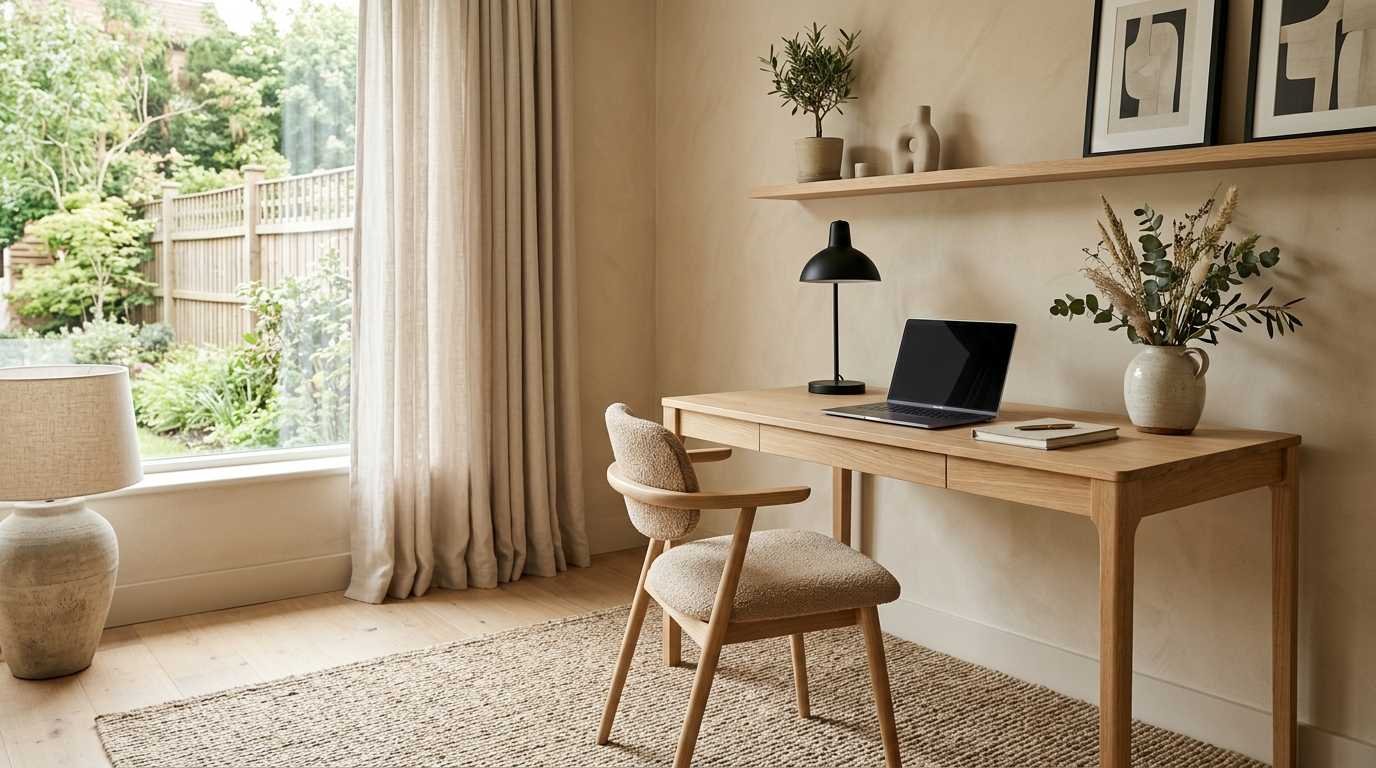

A Japandi home office combines the simplicity of Japanese interiors with the warmth and functionality of Scandinavian design. The result is a workspace that feels calm, uncluttered, natural, and highly intentional without looking cold or overly minimal.
When designing a Japandi office, we focus on clean silhouettes, organic materials, muted colors, practical furniture, and thoughtful decoration. Rather than filling the room with accessories, we select fewer pieces that contribute to comfort, productivity, and visual balance.
Whether we are working with a dedicated room, a bedroom corner, or a compact apartment workspace, the Japandi aesthetic can create an elegant environment that encourages concentration while still feeling inviting.
Table of Contents
1. Start With a Warm Japandi Color Palette
The foundation of a Japandi home office is a soft, neutral color palette. Instead of stark white, we can introduce warmer shades that make the workspace feel sophisticated and comfortable.
Ideal colors include:
- Warm white
- Cream
- Beige
- Sand
- Taupe
- Greige
- Soft gray
- Light brown
- Natural wood tones
- Muted sage green
- Charcoal accents
A simple combination of warm ivory walls, natural oak furniture, beige textiles, and black accents creates an instantly recognizable Japandi atmosphere.
For a more dramatic office, we can use a deeper mushroom, clay, olive, or charcoal shade on one wall. The key is to keep the overall palette restrained so the room remains visually peaceful.
2. Choose a Minimalist Japandi Desk
The desk is the central piece of a home office, so its design has a major influence on the room.
We should look for a desk with:
- Clean, simple lines
- Natural wood construction or finish
- Minimal hardware
- Slim legs
- A practical working surface
- Little or no unnecessary ornamentation
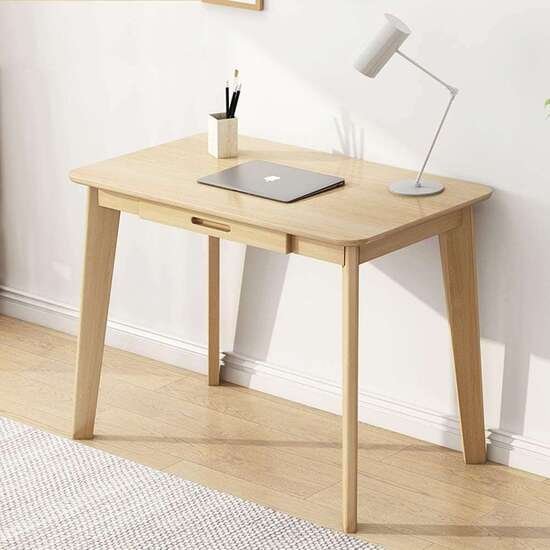
A light oak or walnut desk works particularly well. Scandinavian-inspired desks with rounded corners can soften the room, while Japanese-style desks with a low-profile silhouette create a more grounded appearance.
We should avoid bulky executive desks, excessive drawers, ornate details, and glossy finishes. Japandi interior design relies on visual simplicity.
3. Add an Ergonomic Chair With Organic Appeal
Minimalism should never come at the expense of comfort. Since a Japandi home office needs to support long periods of work, an ergonomic chair is essential.
For a Japandi interior, we can select an ergonomic chair in:
- Beige fabric
- Light gray
- Warm brown
- Black
- Natural leather
- Soft taupe
A contemporary ergonomic chair can work beautifully when its shape is relatively understated. Alternatively, a wooden-framed chair with a woven seat can add Scandinavian or Japanese character.
The goal is to balance ergonomics with aesthetics rather than choosing a chair solely because it looks minimalist.
4. Use Natural Wood to Create Warmth
Natural materials are one of the defining elements of Japandi interiors. Wood introduces warmth into a minimalist space and prevents neutral colors from feeling flat.
Oak, ash, walnut, bamboo, and other natural wood finishes can all work effectively.
We can incorporate wood through:
- Desks
- Shelving
- Cabinets
- Drawer units
- Picture frames
- Desk organizers
- Flooring
- Decorative stools
- Wall panels
Whenever possible, we should allow the natural grain of the wood to remain visible. Excessively polished or artificial finishes can make the room feel less organic.
5. Keep the Desk Clutter-Free
One of the most important Japandi home office ideas is to create intentional storage.
The aesthetic depends heavily on visual calm. A desk covered with paperwork, cables, stationery, and miscellaneous objects will quickly undermine that effect.
We can use:
- Concealed drawers
- Minimal desk organizers
- Wooden storage boxes
- Cable-management trays
- Floating shelves
- Closed cabinets
- Filing drawers
- Decorative baskets
A useful principle is to keep frequently used objects accessible while hiding items that do not need to remain visible.
The result is a workspace that feels cleaner without requiring constant tidying.
6. Incorporate Japandi-Inspired Open Shelving
Open shelving can provide useful storage while giving us an opportunity to introduce carefully selected decorative pieces.
Instead of filling every shelf, we can leave generous negative space between objects.
Consider displaying:
- A small ceramic vase
- A few design books
- A sculptural object
- A simple plant
- Handmade pottery
- A wooden box
- A framed minimalist print
The negative space between accessories is just as important as the accessories themselves.
This prevents the shelves from becoming visually overwhelming.
7. Bring Nature Into the Japandi Home Office
Plants are particularly effective in a Japandi workspace because they reinforce the connection between interior design and nature.
We can choose plants with simple, sculptural forms, such as:
- Olive trees
- Fiddle-leaf figs
- Snake plants
- Bonsai
- Rubber plants
- Pothos
- Small branches in ceramic vessels
A single large plant can often have more impact than several small plants scattered throughout the room.
For a minimalist office, we can place one substantial plant beside the desk or near a window and allow its organic shape to become part of the composition.
8. Choose Simple Japandi Lighting
Lighting should feel soft, warm, and functional.
A Japandi office benefits from several layers of lighting rather than relying entirely on a ceiling fixture.
We can combine:
Ambient lighting: A simple pendant, ceiling fixture, or recessed light provides overall illumination.
Task lighting: A streamlined desk lamp provides focused light for reading and computer work.
Accent lighting: A small floor lamp or wall light can create warmth during the evening.
Warm white bulbs generally complement the natural materials and neutral palette better than extremely cool lighting.
Paper lantern-style lamps, linen shades, ceramic lamps, and minimalist wood fixtures are particularly suitable.
9. Introduce Woven and Textural Materials
A room dominated by hard surfaces can feel sterile. Japandi interiors solve this problem through subtle texture.
We can introduce texture with:
- Linen curtains
- Wool rugs
- Cotton cushions
- Woven baskets
- Rattan accessories
- Handmade ceramics
- Jute rugs
- Bouclé upholstery
- Natural wood
The objective is not to create a heavily layered room. Instead, we want quiet variations in texture that make the minimalist design feel richer.
A neutral wool rug beneath the desk and chair, for example, can make a simple workspace feel significantly more comfortable.
10. Select Minimalist Japandi Wall Decor
Wall decoration should be intentional rather than abundant.
Instead of creating a gallery wall filled with colorful artwork, we can choose one or two substantial pieces.
Good options include:
- Abstract line art
- Japanese-inspired landscapes
- Botanical prints
- Minimalist photography
- Neutral abstract paintings
- Traditional-inspired ink artwork
- Textured handmade art
Natural wood frames or thin black frames can complement the room.
We should leave some walls completely empty. In Japandi interiors, an undecorated wall is not necessarily unfinished; it contributes to the feeling of spaciousness.
11. Use a Japandi Rug to Define the Workspace
A rug can visually anchor the desk and chair, particularly in an open-plan room.
Choose a rug with:
- A neutral color
- Subtle patterning
- Natural texture
- Low visual contrast
- Simple geometric or organic motifs
Cream, beige, oatmeal, taupe, and soft gray are excellent choices.
A large rug positioned beneath the desk and chair can create a defined office zone without requiring a physical partition.
12. Hide Technology Without Losing Functionality
Modern Japandi home office inevitably contain technology, but computers, chargers, monitors, and cables can conflict with the minimalist aesthetic.
We can maintain a clean appearance by using:
- Under-desk cable trays
- Cable sleeves
- Concealed power strips
- Wireless peripherals
- Monitor stands
- Cable boxes
- Built-in storage
- Wall-mounted cable channels
A large monitor can be visually softened with a simple wooden monitor shelf or an understated desk setup.
The objective is not to eliminate technology but to integrate it discreetly into the design.
13. Create a Small Japandi Office in a Corner
We do not need an entire room to achieve the Japandi aesthetic.
For a small apartment or bedroom, we can transform an unused corner into a functional office with a narrow wooden desk, compact chair, floating shelf, and small plant.
Keeping the furniture visually light is especially important in small spaces.
A wall-mounted desk can be an excellent solution because it occupies less floor space and can create a streamlined appearance.
We can also use a narrow vertical storage unit instead of a wide cabinet.
14. Combine Japanese Minimalism With Scandinavian Comfort
The most successful Japandi offices balance two design philosophies.
Japanese minimalism gives us:
- Simplicity
- Balance
- Natural materials
- Intentional emptiness
- Low visual clutter
- Appreciation for craftsmanship
Scandinavian design contributes:
- Warmth
- Comfort
- Practicality
- Soft textiles
- Functional furniture
- Inviting neutral colors
Combining these characteristics creates an office that feels minimalist without becoming severe.
15. Add Handmade Ceramics and Artisanal Details
Handcrafted objects provide character without overwhelming the minimalist composition.
A handmade ceramic mug, imperfect vase, textured bowl, or sculptural object can introduce subtle individuality.
We should favor pieces that show natural variation rather than perfectly uniform mass-produced accessories.
This approach reinforces the Japandi appreciation for craftsmanship, simplicity, and natural imperfection.
16. Use Curtains to Soften the Space
Window treatments can dramatically influence the atmosphere of a Japandi home office.
For a Japandi room, linen or linen-look curtains in cream, oatmeal, beige, or soft gray work particularly well.
Sheer curtains can filter daylight while maintaining an airy appearance. If privacy is important, we can layer sheer curtains with heavier neutral panels.
Avoid highly decorative patterns or heavy formal draperies that compete with the room’s understated character.
17. Create a Calm Background for Video Calls
A well-designed Japandi office can also create an attractive background for virtual meetings.
Rather than positioning the desk directly against a visually busy wall, we can create a simple composition behind the workspace.
A neutral wall, floating wooden shelf, plant, ceramic vase, and one piece of artwork can provide enough visual interest without appearing distracting.
This creates a professional background while maintaining the calm atmosphere of the room.
18. Add Black Accents for Definition
Although Japandi interiors are often associated with light neutrals, small black accents can add structure.
We can use black through:
- Desk legs
- Lighting fixtures
- Window frames
- Picture frames
- Cabinet handles
- Monitor stands
- Decorative objects
The key is moderation. A few carefully positioned black details create contrast and help prevent an all-neutral room from appearing flat.
19. Prioritize Function Before Decoration
A beautiful Japandi home office still needs to work efficiently.
Before adding decorative accessories, we should consider:
- Where the computer will be positioned
- How much desk space is needed
- Where documents will be stored
- How cables will be managed
- Whether the chair provides proper support
- How natural light enters the room
- Where additional lighting is required
- How frequently used supplies will be accessed
Once these practical requirements are solved, decoration becomes much easier.
This is particularly important in Japandi design because functionality is part of the aesthetic.
20. Finish the Room With Intentional Accessories
The final layer should consist of only a few meaningful objects.
A simple Japandi home office might include a wooden desk, ergonomic chair, ceramic desk lamp, small plant, linen curtain, textured rug, one piece of artwork, and a handcrafted vase.
That is enough.
The room does not need dozens of decorative objects to feel finished. In fact, reducing accessories can make each individual piece more noticeable.
Final Thoughts on Japandi Home Office Design
A beautiful Japandi home office is built around simplicity, natural materials, functionality, and visual balance. We can achieve the aesthetic without completely redesigning a room or purchasing an entire matching furniture collection.
Start with a warm neutral palette, add natural wood, choose a simple desk and comfortable chair, introduce soft textures, conceal clutter, and finish with a small number of thoughtfully selected accessories.
The most successful spaces feel effortless because every element has a purpose. By combining Japanese simplicity with Scandinavian warmth, we can create a home office that feels peaceful enough for focused work, comfortable enough for long days, and refined enough to become a natural extension of the home.


Leave a Reply