
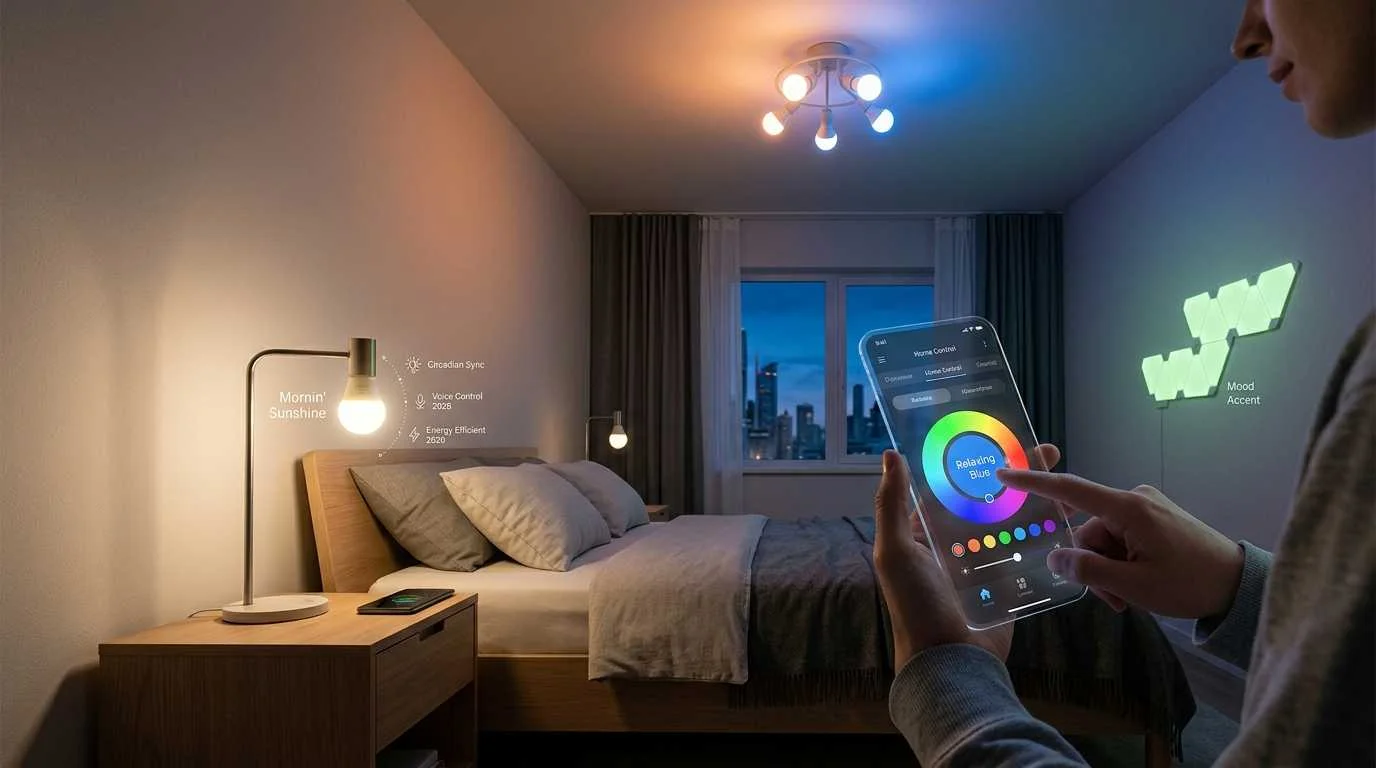

The best smart light bulbs for a bedroom do more than turn on and off from a phone. They can transform the atmosphere of the room, provide comfortable light for reading, create a softer evening environment, and automate your lighting around your daily routine.
A bedroom needs a different approach to lighting than a kitchen or home office. Extremely bright, cool-white illumination may be useful when you need to work or clean, but a bedroom generally benefits from dimmable, warm, adjustable lighting that can transition throughout the day.
For most bedrooms, look for a smart bulb that offers smooth dimming, adjustable color temperature, reliable scheduling, voice control, and compatibility with your existing smart-home ecosystem.
Modern options also increasingly support Matter, making it easier to connect compatible lighting products with platforms such as Apple Home, Google Home, Alexa, and SmartThings.
Table of Contents
What Makes a Smart Light Bulb Good for a Bedroom?
Not every smart bulb is equally suitable for a bedroom.
A bulb can have millions of colors and impressive app features yet still be uncomfortable to use beside the bed if it doesn’t dim smoothly or produce sufficiently warm light.
The most important characteristics include:
- Warm color temperatures for evening use
- Smooth dimming at low brightness
- Adequate lumens for reading and getting dressed
- Tunable white light when possible
- Scheduling and automation
- Voice control
- Reliable connectivity
- Compatibility with your smart-home platform
- Matter support if cross-platform compatibility matters
- A suitable bulb shape and base for the existing fixture
For a bedroom, the ability to create a gentle transition from brighter daytime lighting to warmer evening illumination can be more useful than having dozens of novelty color effects.
Best Smart Light Bulbs for Bedroom: Quick Comparison
| Smart Bulb | Best For | Key Advantage |
|---|---|---|
| Philips Hue | Premium bedrooms | Excellent ecosystem and lighting control |
| Govee Smart Bulb | Best value | Strong features and color options |
| Nanoleaf Essentials | Matter/Thread homes | Matter and Thread compatibility |
| LIFX Color | Vibrant colors | Excellent color effects |
| TP-Link Tapo | Budget setups | Affordable smart lighting |
| Sengled Matter Bulb | Simple Matter setups | Hub-free smart-home integration |
| WiZ Smart Bulb | Everyday automation | Flexible app-based control |
| GE Cync | Alexa-focused homes | Strong smart-home features |
The right choice depends less on having the longest feature list and more on how you intend to use the bulb.
1. Philips Hue – Best Premium Smart Light Bulb for Bedroom
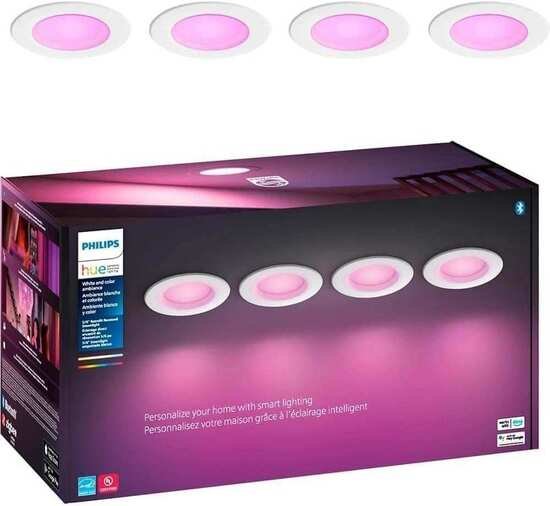
Philips Hue remains one of the strongest choices for homeowners who want a sophisticated smart-lighting system rather than a single connected bulb.
Its biggest advantage is the maturity of the Hue ecosystem. A bedroom can start with one or two bulbs and eventually expand into bedside lamps, accent lighting, ceiling fixtures, and other rooms.
Hue is particularly attractive when reliable dimming, scenes, automation, and ecosystem integration are priorities.
The White and Color Ambiance range provides adjustable white light and millions of colors, while the broader Hue platform offers extensive scene and automation options. Current Hue products also increasingly integrate with Matter-enabled smart-home environments.
Why choose Philips Hue for a bedroom?
- Excellent dimming
- Extensive lighting scenes
- Strong ecosystem
- Voice-control compatibility
- Broad smart-home integration
- Excellent option for multi-room lighting
- Suitable for sophisticated bedtime routines
The main disadvantage is price. Hue generally costs more than basic Wi-Fi smart bulbs, and some advanced setups benefit from the Hue Bridge.
Best for: Homeowners building a premium smart-home lighting system.
2. Govee Smart Light Bulb – Best Value for Most Bedrooms
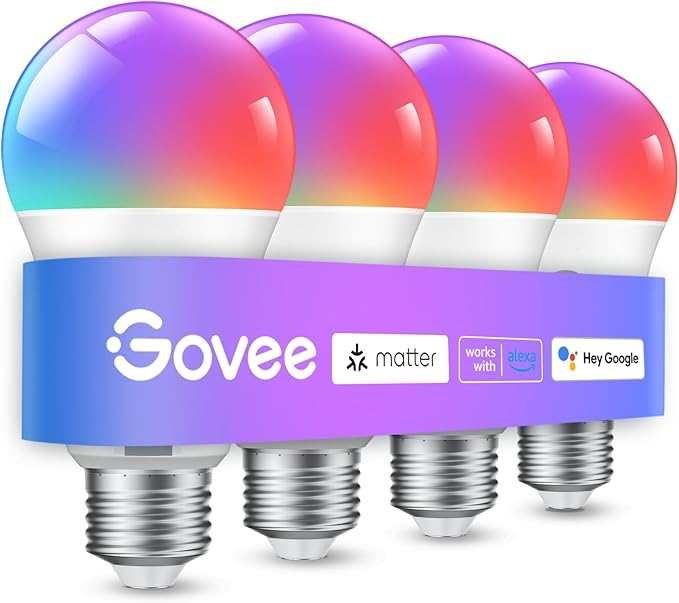
Govee offers an appealing combination of price, smart features, color effects, and automation.
Its smart bulbs are available in different brightness levels and configurations, making them suitable for everything from bedside lamps to general bedroom lighting.
Some current Govee models support Matter, Wi-Fi, Bluetooth, voice assistants, and extensive color effects. This makes them particularly attractive if you want smart lighting without committing to an expensive proprietary ecosystem.
For a bedroom, the ability to create warm scenes and automate brightness can be more valuable than the extensive RGB effects.
Best Govee bedroom uses
A Govee bulb can be programmed for a simple routine:
Morning: brighter, cooler illumination
Afternoon: balanced neutral white
Evening: warmer, lower-intensity lighting
Bedtime: very dim, warm illumination
That approach turns an inexpensive smart bulb into a much more useful bedroom-lighting system.
Best for: Shoppers who want lots of features without paying premium ecosystem prices.
3. Nanoleaf Essentials – Best for Matter and Thread
For a modern smart home built around Matter and Thread, Nanoleaf Essentials is worth considering.
Matter is designed to make compatible smart-home devices work more easily across different platforms. Nanoleaf’s Matter-compatible bulbs can therefore be particularly useful when different members of a household use different smart-home ecosystems.
Current Matter lighting options include adjustable whites and color lighting, while Thread can provide a responsive mesh connection when the required Thread infrastructure is available.
Why Nanoleaf works well in bedrooms
The advantage isn’t simply color-changing capability.
A Matter-based bulb can become part of a larger routine involving:
- Bedside lighting
- Motion sensors
- Smart speakers
- Morning routines
- Evening schedules
- Other Matter-compatible devices
Best for: Tech-focused bedrooms and households that want platform flexibility.
4. LIFX Color – Best Smart Bulb for Bedroom Ambiance
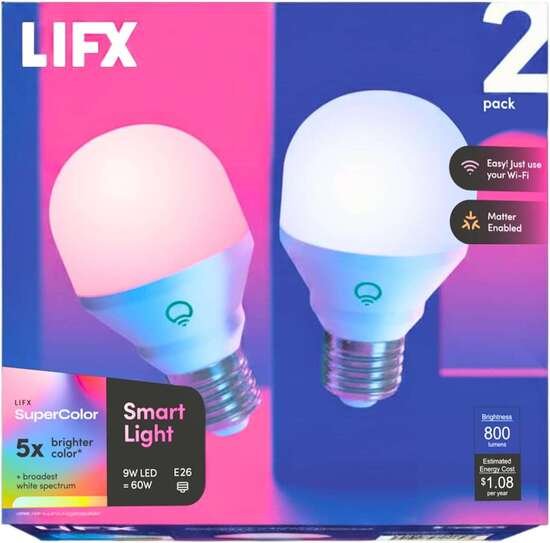
LIFX is an excellent option when color quality and atmospheric lighting are more important than keeping the setup inexpensive.
LIFX bulbs connect directly through Wi-Fi and don’t require a traditional dedicated hub for basic operation. Current LIFX color products also support Matter, depending on the model.
The appeal in a bedroom is obvious.
Instead of simply selecting “white,” you can create a warm amber environment, a subtle red-toned scene, or a colorful accent around a bed or reading corner.
However, colorful lighting shouldn’t replace functional bedroom illumination. For everyday use, adjustable white light is generally more practical.
Best for: Anyone who treats bedroom lighting as part of the room’s interior design.
5. TP-Link Tapo – Best Budget Smart Bulb
TP-Link’s Tapo lighting range is worth considering for shoppers who want affordable smart bulbs without unnecessary complexity.
Budget bulbs can provide the basics particularly well: remote control, dimming, schedules, scenes, and voice integration.
Tapo has also become increasingly relevant for Matter-focused smart homes, depending on the specific model. Current smart-bulb comparisons frequently position Tapo among the value-oriented options.
A Tapo bulb makes sense if you need several bulbs for a bedroom but don’t want to spend premium prices on every fixture.
Best for: Budget-conscious bedrooms and multi-bulb setups.
6. Sengled Matter Smart Bulb – Best for Simple Smart-Home Integration
Sengled’s Matter-compatible bulbs are another practical choice for homeowners who want straightforward smart lighting.
Matter can be particularly useful when you don’t want to be locked into one manufacturer’s ecosystem. Depending on the model and smart-home controller, compatible bulbs can be integrated with major platforms including Apple Home, Google Home, Alexa, and SmartThings.
The important point is to check the exact model before buying because Matter compatibility, connectivity method, brightness, and color capabilities can vary between products.
Best for: Simple cross-platform smart-home installations.
How Many Lumens Do You Need for a Bedroom?
Brightness is measured in lumens, not watts.
For a typical bedroom, an 800-lumen bulb can be a practical starting point for a standard lamp or fixture. Larger bedrooms may benefit from multiple bulbs rather than relying on one extremely bright source.
A useful approach is to layer the lighting.
For bedside lamps
Choose moderate brightness with excellent dimming.
The goal is comfortable reading light when needed and a very low setting when winding down.
For ceiling fixtures
Consider multiple bulbs so the overall room can be illuminated evenly.
For accent lighting
Lower-output bulbs can create atmosphere without dominating the room.
The best bedroom lighting isn’t necessarily the brightest. Flexibility is more important.
What Color Temperature Is Best for a Bedroom?
Color temperature is measured in Kelvin (K).
Lower numbers generally produce warmer, more amber-colored light, while higher numbers create cooler, more daylight-like illumination.
For bedroom lighting, a useful range is:
- 2200K–2700K: Very warm and relaxing
- 2700K–3000K: Comfortable everyday bedroom lighting
- 3000K–4000K: More neutral and useful for tasks
- 5000K–6500K: Cool daylight appearance
A bedroom doesn’t need to stay at one color temperature all day.
A smarter setup can use warmer light at night and brighter, cooler light earlier in the day. Several bedroom-lighting guides recommend approximately 2200K–2700K for evening wind-down lighting, with brighter and cooler settings reserved for daytime activities.
Why Dimming Matters More in a Bedroom
Dimming is one of the most important features to examine before buying a smart bulb.
A bulb that only dims from 100% to 20% may still feel surprisingly bright when the room is dark.
Premium smart bulbs can provide much lower brightness levels with smoother transitions. Philips Hue, for example, is frequently noted for particularly smooth low-level dimming.
For bedside lighting, the ideal smart bulb should allow you to create settings such as:
Reading: 60–80%
Relaxing: 20–40%
Getting ready for bed: 10–20%
Midnight navigation: very low brightness
The exact percentages will depend on the bulb and room.
Smart Bedroom Lighting Routines Worth Creating
Once a smart bulb is installed, automation is where it becomes genuinely useful.
Sunset Routine
Schedule the bedroom lights to gradually become warmer and dimmer during the evening.
This creates a more intentional transition between daytime activity and nighttime relaxation.
Bedtime Routine
At a predetermined time, reduce brightness and switch to a warm color temperature.
You don’t have to remember to adjust the lights manually.
Morning Routine
Gradually increase brightness in the morning rather than immediately switching on a bright ceiling fixture.
Some smart lighting ecosystems specifically offer sunrise-style routines, which can be useful for creating a gentler morning environment.
Away Mode
If you’re traveling, automated lighting can make the home appear occupied.
This isn’t specifically a bedroom feature, but it’s a useful advantage of smart lighting throughout the home.
Wi-Fi vs. Bluetooth vs. Matter vs. Zigbee
Connectivity deserves attention before purchasing multiple smart bulbs.
Wi-Fi
Wi-Fi bulbs connect directly to your home network.
Advantages:
- Usually no dedicated hub
- Easy remote access
- Familiar setup
Disadvantages:
- Multiple bulbs can add network traffic
- Performance depends on Wi-Fi coverage
Bluetooth
Bluetooth can work well for a single room or simple local control.
However, it may offer less flexibility than a fully connected smart-home system.
Zigbee
Zigbee is widely used in established smart-lighting ecosystems and can provide reliable communication through a compatible hub.
Matter
Matter is increasingly important because it is designed to improve interoperability between smart-home platforms.
However, Matter doesn’t automatically mean every advanced manufacturer feature will be available through every platform. Features such as specialized scenes or manufacturer-specific effects may still require the brand’s own application.
Do Smart Light Bulbs Need a Hub?
Not necessarily.
Many modern smart bulbs connect directly through Wi-Fi or Bluetooth.
Others use a hub-based system for additional reliability, functionality, or ecosystem features.
For example, Philips Hue can operate through Bluetooth in simpler installations, while a Hue Bridge provides broader system capabilities.
A hub isn’t inherently better or worse.
If you only need two bedside bulbs, a hub-free system may be more convenient.
If you’re planning a whole-home lighting system with numerous bulbs and sophisticated automation, an ecosystem with a dedicated hub can make more sense.
Are Color-Changing Smart Bulbs Worth It for a Bedroom?
Yes, but color isn’t the most important feature.
For most people, adjustable white light and smooth dimming are more useful every day than RGB effects.
Color becomes valuable when you want to:
- Create a romantic atmosphere
- Add decorative accent lighting
- Build themed scenes
- Coordinate lighting with entertainment
- Change the bedroom’s mood
- Use subtle colored night lighting
If you’re buying your first bedroom smart bulb, prioritize dimming and adjustable white light first.
RGB comes afterward.
How to Choose the Best Smart Light Bulb for Your Bedroom
Before purchasing, check these seven things.
1. Check the Bulb Base
The bulb must physically fit the fixture.
E26 and E27 bases are common in many markets, but fixtures vary.
2. Measure Brightness
Look at lumens, rather than relying on wattage comparisons.
3. Check Color Temperature
For bedrooms, prioritize bulbs capable of reaching warm settings around 2200K–2700K if you want especially warm evening light.
4. Examine the Dimming Range
A bulb that dims smoothly to very low levels is particularly useful beside the bed.
5. Check Your Smart-Home Platform
Before buying, verify compatibility with your existing setup.
If you use Alexa, Google Home, Apple Home, or SmartThings, make sure the specific bulb supports the platform you actually use.
6. Consider Matter
If you’re building a smart home for the long term, Matter compatibility can provide additional flexibility.
7. Don’t Ignore the App
The manufacturer’s app controls your initial setup and often provides features unavailable through third-party platforms.
A technically impressive bulb isn’t very useful if its app is frustrating or unreliable.
Best Smart Light Bulb for Bedroom: Final Verdict
The best smart light bulb for a bedroom depends on how you want the room to function.
For a premium, expandable lighting ecosystem, Philips Hue remains one of the strongest choices.
For shoppers who want an impressive feature-to-price balance, Govee is a compelling option.
For a modern Matter-based smart home, Nanoleaf Essentials deserves serious consideration.
For highly atmospheric color lighting, LIFX is particularly appealing.
And if affordability is the priority, TP-Link Tapo or Sengled Matter bulbs can provide the core smart-lighting functions without requiring a premium ecosystem.
Ultimately, the most useful bedroom bulb isn’t necessarily the one with the most colors or the highest brightness.
It’s the one that lets the room be bright when you need it, warm when you want to relax, and dim when it’s time to sleep.








Leave a Reply