
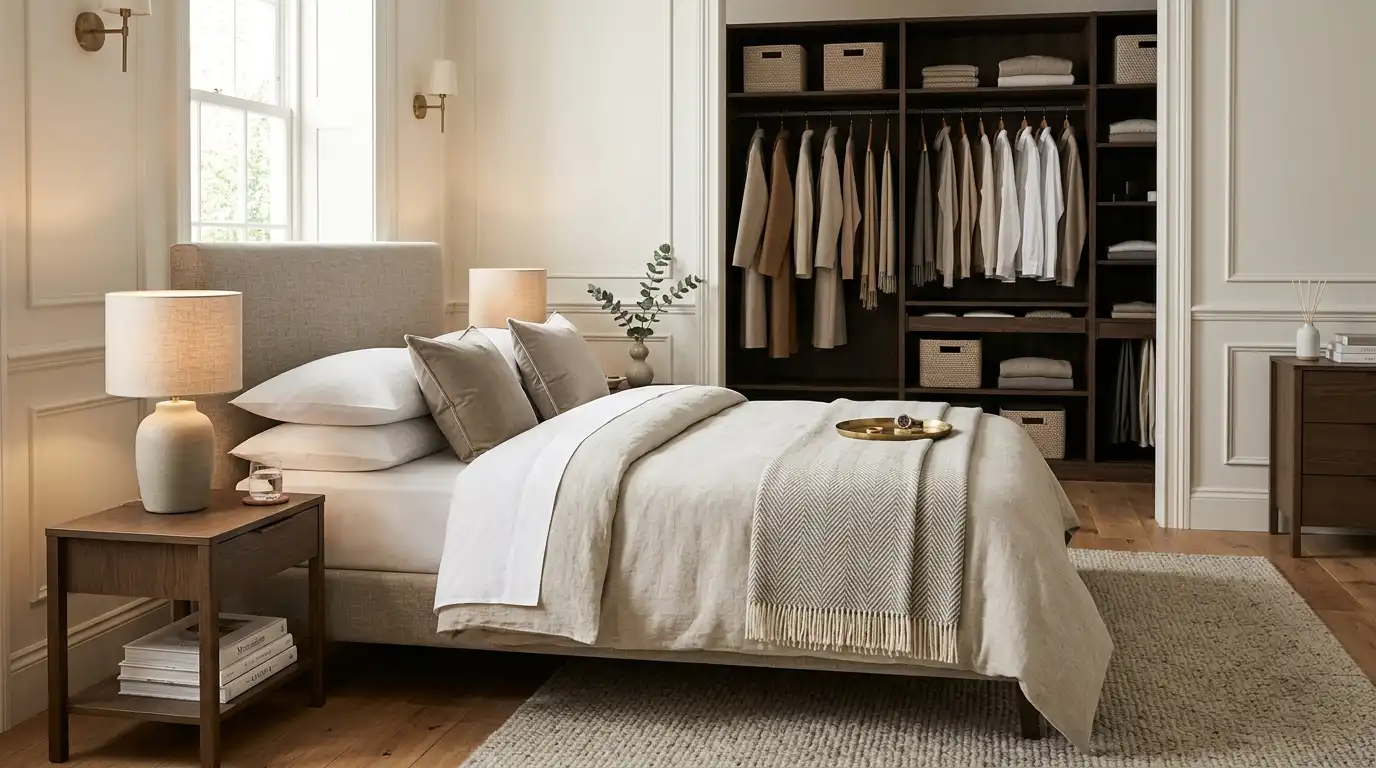

A beautifully organized bedroom can change how the entire room feels. When clothes have a home, surfaces stay clear, and everyday essentials are easy to reach, the space feels calmer before you even get into bed.
This Ultimate Bedroom Organization Checklist takes you through the bedroom piece by piece, from wardrobes and bedside tables to hidden storage, linens, accessories, and those small clutter zones that are easy to overlook.
The goal is simple: create a bedroom that feels polished enough for a boutique hotel while remaining comfortable enough for everyday life.
Suggested Reads: Bedroom Design PDF: Complete Bedroom Guide
Table of Contents
Ultimate Bedroom Organization Checklist at a Glance
Use this checklist as your master bedroom reset. You can complete it in one afternoon or work through one section each day.
| Bedroom Area | What to Organize | Main Goal |
|---|---|---|
| Bed | Pillows, blankets, throws | Keep bedding neat |
| Nightstands | Books, chargers, accessories | Clear visual clutter |
| Wardrobe | Clothing, shoes, accessories | Make dressing easier |
| Drawers | Underwear, socks, small items | Give every category a place |
| Dresser | Clothing and surface items | Keep surfaces restrained |
| Vanity | Beauty and grooming products | Make daily routines easier |
| Linens | Sheets, towels, blankets | Store by category |
| Shoes | Everyday and occasion pairs | Protect and separate |
| Accessories | Jewelry, belts, scarves | Prevent tangling |
| Hidden Storage | Under-bed and unused areas | Use overlooked space |
| Décor | Art, candles, objects | Keep the room visually calm |
| Floor | Bags, laundry, loose items | Maintain open space |
1. Start With a Complete Bedroom Reset
Before buying storage containers or rearranging furniture, empty the obvious clutter.
Walk around the room with four containers or bags labeled:
- Keep
- Relocate
- Donate
- Discard
Pick up everything that has landed where it doesn’t belong. Cups, receipts, clothing, packaging, books, beauty products, chargers and miscellaneous objects all count.
Then return items to their proper rooms before organizing the bedroom itself.
This first pass makes the remaining work much easier because you’re working with the things you genuinely use.
Use the Four-Question Test
For every questionable item, ask:
- Do I use this regularly?
- Does it belong in the bedroom?
- Does it have a specific home?
- Would I choose to keep it if I were organizing the room from scratch?
You don’t need to become extremely minimalist. A luxurious bedroom can contain books, photographs, perfume, decorative objects and personal treasures.
The difference comes from giving those things enough space to breathe.
2. Make the Bed the Visual Anchor
The bed usually occupies the largest area of the bedroom, so its condition has an outsized effect on how organized the room appears.
Start with the basics:
- Wash and fully dry the sheets.
- Rotate or replace worn bedding.
- Fold spare blankets.
- Arrange pillows consistently.
- Remove unused decorative cushions.
- Store seasonal bedding elsewhere.
- Keep one attractive throw within easy reach.
A simple bedding arrangement often looks more expensive than a bed overloaded with layers.
For a polished bedroom, choose a restrained combination of textures. Crisp cotton sheets, a quilted coverlet, a soft throw and a few well-chosen pillows can create plenty of visual interest.
Keep Spare Bedding Together
Store complete bedding sets together whenever possible.
One useful method is to fold the fitted sheet, flat sheet and matching pillowcases into one pillowcase. This prevents the classic problem of finding a fitted sheet with no matching pieces months later.
3. Clear and Organize the Nightstands
Nightstands become clutter magnets because they sit within arm’s reach.
Start by removing everything and wiping the surface.
Then sort the contents into three groups:
Daily essentials: phone, glasses, medication, water and a small reading light.
Occasional items: notebooks, extra chargers, beauty products and miscellaneous objects.
Decorative items: books, candles, flowers, framed photographs or a small lamp.
Return only the things you genuinely want beside the bed.
A good nightstand often needs surprisingly little: a lamp, one or two books, a small decorative object and the essentials you use every night.
Create a Charging Station
Loose cables can make an otherwise beautiful bedroom look messy.
Use a cable organizer, charging dock or discreet cable clips to keep wires under control. Route chargers toward the back of the nightstand where possible.
If you charge several devices overnight, consider dedicating one drawer to charging equipment.
4. Organize the Wardrobe by Category
Your wardrobe deserves the largest part of the organization checklist because clothing usually represents the biggest source of bedroom storage pressure.
Start by taking everything out of one section at a time.
Group clothing into categories such as:
- Dresses
- Shirts
- Blouses
- T-shirts
- Trousers
- Jeans
- Skirts
- Jackets
- Knitwear
- Sleepwear
- Workout clothing
- Seasonal pieces
Then arrange each category in a logical sequence.
You can organize clothing by color within each category if that makes getting dressed easier.
Give Frequently Worn Clothes Prime Space
Place everyday clothing between shoulder and eye level.
Less frequently worn items can occupy higher shelves, deeper drawers or secondary storage.
Formal clothing, seasonal coats and special-occasion pieces generally require less accessible storage than your everyday wardrobe.
This small change can make mornings much easier.
5. Give Drawers a Specific Job
A drawer filled with unrelated objects quickly becomes difficult to maintain.
Assign each drawer a category.
For example:
- Drawer 1: underwear
- Drawer 2: socks and hosiery
- Drawer 3: sleepwear
- Drawer 4: workout clothing
- Drawer 5: accessories
Drawer dividers can help prevent smaller items from becoming one large pile.
You don’t need a divider for every drawer. Use them where categories tend to collapse into each other.
Fold Clothing According to the Drawer
Fold items into compact rectangles and place them vertically when practical. You’ll be able to see more pieces without lifting an entire stack.
This works particularly well for T-shirts, pajamas, workout clothing and lightweight knitwear.
6. Organize Your Dresser
The dresser top is one of the most visible surfaces in the bedroom.
Clear it completely before deciding what deserves to remain.
A refined dresser arrangement might include:
- One mirror or framed artwork
- A small tray
- A perfume bottle or two
- A jewelry box
- A vase
- One decorative object
The exact combination depends on your taste.
The useful rule is to create intentional groupings rather than scattering small objects across the entire surface.
Use a Tray for Small Essentials
A tray creates a visual boundary.
Perfume, a watch, sunglasses or everyday jewelry can sit together inside it instead of spreading across the dresser.
It also makes cleaning easier because several objects can be moved at once.
7. Tackle the Vanity and Beauty Area
Bedrooms often accumulate beauty products that don’t belong on display.
Remove everything from your vanity, dresser or beauty station.
Separate products into:
- Daily skincare
- Makeup
- Hair products
- Fragrance
- Nail care
- Grooming tools
- Backups
- Products you no longer use
Check expiration dates where relevant and discard products that have changed in smell, texture or appearance.
Keep everyday products accessible and store backups together.
A small drawer organizer can separate makeup categories, while a lidded box works well for less frequently used items.
8. Organize Jewelry and Accessories
Jewelry becomes difficult to manage when necklaces, bracelets and earrings are stored together.
Separate accessories by type.
Jewelry
Use:
- Divided jewelry trays
- Small individual compartments
- Necklace hooks
- Earring organizers
- Ring dishes
Keep delicate pieces separated to reduce tangling and scratching.
Scarves and Belts
Roll soft scarves loosely or fold them into a drawer.
Belts can be rolled individually or stored on a dedicated hanger.
Watches and Sunglasses
A lined watch box or divided drawer keeps these pieces protected while making them easy to find.
The luxury approach here is simple: treat accessories as objects worth caring for.
9. Create a Better Shoe Storage System
Shoes scattered around the bedroom quickly make the floor look crowded.
Start by separating them into:
- Everyday shoes
- Formal shoes
- Seasonal footwear
- Athletic shoes
- Special-occasion pairs
Keep your most frequently worn pairs easiest to reach.
Store occasion shoes higher up or in another dedicated area.
If your wardrobe has limited floor space, vertical shoe storage can make better use of the available height.
10. Organize Your Linen Storage
Linen storage becomes much easier when every category has a defined location.
Separate:
- Bed sheets
- Pillowcases
- Duvet covers
- Blankets
- Quilts
- Mattress protectors
- Seasonal bedding
Store similar items together.
If you have multiple bedrooms, label storage by room or bed size.
Avoid stuffing linen shelves until they barely close. Fabrics need room to be folded and removed without pulling everything else down.
11. Make Use of Under-Bed Storage
The space underneath the bed is valuable storage real estate.
Use it for items you don’t need every day, such as:
- Seasonal clothing
- Spare bedding
- Travel bags
- Occasion shoes
- Extra blankets
Choose containers that slide easily and have lids or fabric covers.
Avoid storing items directly on the floor. Dust accumulates quickly under beds, and cleaning becomes harder.
A low-profile storage box with handles can make seasonal rotation much easier.
12. Create a Dedicated Laundry System
Clothing on the floor is one of the fastest ways to undo an organized bedroom.
Place a laundry hamper where you naturally remove clothing.
If space allows, use separate compartments for different wash categories.
A lidded hamper can keep the room looking tidy between laundry days.
The best laundry system is the one that requires the fewest extra steps. If the hamper is inconveniently placed, clothing will eventually end up on a chair or floor.
13. Deal With the Chair Clothes Problem
Almost every bedroom has one.
A chair becomes the temporary home for jeans, jackets, sweaters and clothing that’s been worn once.
Give those clothes a clear decision:
Clean: return them to the wardrobe.
Ready to wear again: designate one hook or rail for lightly worn clothing.
Dirty: put them in the laundry hamper.
A single dedicated hook can prevent the chair from becoming a secondary wardrobe.
14. Organize Books and Personal Items
Books can make a bedroom feel personal and sophisticated, but too many scattered stacks create visual noise.
Choose one location for your current reading.
Keep a small selection on the nightstand or a nearby shelf.
Store the rest vertically on a bookcase or in another room.
You can also create a small reading corner with a comfortable chair, floor lamp and side table if your bedroom has enough space.
That gives books a natural home instead of allowing them to migrate around the room.
15. Edit Bedroom Décor
Organization includes visual organization.
Look around the room and identify objects that compete for attention.
You may have:
- Too many framed photographs
- Several decorative trays
- Excess cushions
- Multiple candles
- Small ornaments scattered across surfaces
- Unused decorative boxes
Choose the pieces that contribute something meaningful to the room.
A refined bedroom benefits from negative space. Empty space around beautiful objects gives those objects more presence.
16. Organize Technology
Bedrooms can accumulate technology surprisingly quickly.
Create a small technology category for:
- Phone chargers
- Tablet chargers
- Headphones
- Smartwatch accessories
- Spare cables
- Power banks
- Remote controls
Keep frequently used equipment accessible and store duplicates together.
A labeled cable pouch can prevent the drawer full of mysterious wires that nobody wants to sort later.
17. Check the Forgotten Clutter Zones
The most overlooked bedroom clutter often hides in small areas.
Add these places to your checklist:
- Behind the nightstand
- Under the bed
- Inside bedside drawers
- Behind the bedroom door
- Top shelves
- Wardrobe corners
- Dresser drawers
- Vanity drawers
- Inside handbags
- Under furniture
- Window ledges
- Decorative baskets
These areas don’t need daily attention.
A monthly or seasonal check is usually enough.
18. Build a Simple Weekly Reset
A bedroom stays organized when the maintenance routine is small.
Try this 10-minute reset at the end of the day:
- Put clothing away.
- Place shoes together.
- Clear the nightstand.
- Return books to their home.
- Put beauty products away.
- Remove cups and dishes.
- Empty obvious rubbish.
- Straighten the bed.
- Close wardrobe doors and drawers.
- Open the curtains and let the room breathe.
The routine works because it handles small messes before they become a weekend project.
19. Use the Luxury Hotel Test
Once you’ve finished organizing, stand at the bedroom entrance.
Look at the room as though you’re seeing it for the first time.
Ask:
- Does the bed look inviting?
- Are surfaces mostly clear?
- Can I walk around comfortably?
- Are cables hidden or controlled?
- Are clothing piles visible?
- Does every major category have a home?
- Do the decorative pieces feel intentional?
- Is anything visually distracting?
Then make one final edit.
Remove one object from each cluttered surface if the room still feels busy.
Luxury often comes from restraint: fewer things, better placement, better materials and more breathing room.
Ultimate Bedroom Organization Checklist: Printable Version
Use this condensed version when you’re ready for the actual bedroom reset.
Bedroom Reset
- Remove rubbish
- Remove dishes and cups
- Collect misplaced items
- Sort items into keep, relocate, donate and discard
- Clean visible surfaces
- Vacuum or sweep the floor
Bed
- Wash bedding
- Fold spare blankets
- Arrange pillows
- Remove unnecessary cushions
- Store seasonal bedding
- Check mattress protector
Nightstands
- Remove everything
- Clean the surface
- Sort drawer contents
- Organize charging cables
- Keep daily essentials accessible
- Remove unnecessary objects
Wardrobe
- Remove unwanted clothing
- Separate seasonal pieces
- Group clothing by category
- Arrange frequently worn items within easy reach
- Organize shelves
- Organize hanging clothes
- Sort wardrobe accessories
- Review shoes
Drawers
- Sort underwear
- Organize socks
- Fold sleepwear
- Separate workout clothing
- Add dividers where useful
- Remove damaged or unused pieces
Dresser
- Clear the surface
- Clean the top
- Organize drawers
- Create a small accessory tray
- Remove visual clutter
Vanity
- Sort skincare
- Sort makeup
- Organize hair products
- Review fragrances
- Remove expired or unwanted products
- Store backup products together
Accessories
- Separate jewelry
- Organize watches
- Store sunglasses
- Roll or fold scarves
- Organize belts
- Store handbags properly
Storage
- Check under the bed
- Organize linen storage
- Label seasonal storage
- Check wardrobe corners
- Review hidden drawers
- Clean behind furniture
Final Styling
- Clear the floor
- Remove excess décor
- Arrange books
- Hide or organize cables
- Straighten curtains
- Add one or two finishing touches
- Complete a final visual edit
Common Bedroom Organization Mistakes
Buying Storage Before Decluttering
Storage products can’t solve an excess-of-stuff problem.
Sort your belongings first. Then measure the space and choose storage that fits what remains.
Filling Every Surface
A dresser, nightstand or vanity doesn’t need to display every beautiful object you own.
Leave breathing room between decorative pieces.
Creating Complicated Systems
An organization system should be easy enough to maintain on a busy Tuesday evening.
If putting something away requires five steps, you’ll probably stop doing it.
Ignoring Vertical Space
Walls, wardrobe doors and tall shelving can provide useful storage without taking additional floor area.
Hooks, rails and shelves can be particularly helpful in smaller bedrooms.
Keeping Everything in the Bedroom
Bedrooms work best when they contain the things you actually need there.
Move office supplies, old paperwork, random electronics and unrelated household items to more suitable locations.
How Often Should You Organize Your Bedroom?
A quick daily reset can take five to ten minutes.
Do a more thorough organization once a month, focusing on drawers, surfaces and clothing.
Seasonal changes are a good opportunity for a deeper reset. Rotate clothing, review bedding, inspect storage areas and remove things that have stopped earning their space.
A complete bedroom organization session may take several hours, depending on the size of your wardrobe and how much accumulated clutter you have.
Key Takeaways
- Start with decluttering before buying storage products.
- Give every major category a defined home.
- Keep everyday clothing and essentials easy to reach.
- Use drawers, wardrobe height and under-bed space intelligently.
- Keep nightstands and dressers visually restrained.
- Organize accessories separately to protect them and prevent tangling.
- Create a simple 5–10 minute bedroom reset.
- Treat organization as part of the room’s design, not just a cleaning task.
- Leave empty space around important furniture and decorative pieces.
- Review seasonal clothing, bedding and hidden storage regularly.
A well-organized bedroom doesn’t require a huge wardrobe, expensive furniture or a minimalist lifestyle. It requires thoughtful placement, sensible storage and a little discipline.
Once everything has a home, maintaining the room becomes far easier—and the bedroom can return to what it should be: a quiet, comfortable part of your home that feels good to walk into every evening.
Suggested Reads: Mastering Bedroom Decor: Stylish Ideas for a Cozy Space
Frequently Asked Questions
What is the best way to organize a bedroom?
Start by decluttering, then assign every major category a specific storage location. Organize clothing, bedding, accessories and daily essentials separately, while keeping frequently used items within easy reach.
How do I organize a small bedroom?
Use vertical storage, under-bed containers, multifunctional furniture and wall-mounted hooks. Keep the floor and major surfaces as open as possible to preserve a sense of space.
What should go in a bedroom nightstand?
Keep only items you regularly use at night or first thing in the morning. Common examples include a lamp, glasses, a book, water, a phone charger and a small personal item.
How can I make my bedroom look more luxurious?
Focus on order, proportion, quality textiles and visual restraint. Coordinated bedding, clear surfaces, thoughtful lighting and a limited number of decorative objects can make the room feel considerably more refined.
How do I stop clothes from piling up on a bedroom chair?
Give lightly worn clothing a dedicated hook or rail. Clean clothing goes back into the wardrobe, dirty clothing goes into the hamper, and clothing that needs attention gets its own defined location.
How often should I declutter my bedroom?
A light weekly reset keeps everyday clutter under control. Review drawers, wardrobes and hidden storage monthly or seasonally, depending on how quickly the space becomes crowded.
Is under-bed storage a good idea?
Yes. Under-bed storage works particularly well for seasonal clothing, spare bedding, luggage and occasion items. Use covered containers and keep the area clean.
How can I keep my bedroom organized long term?
Give every category a specific home and make your daily reset extremely simple. Returning items immediately after use prevents small amounts of clutter from becoming a large organizing project.




Leave a Reply