
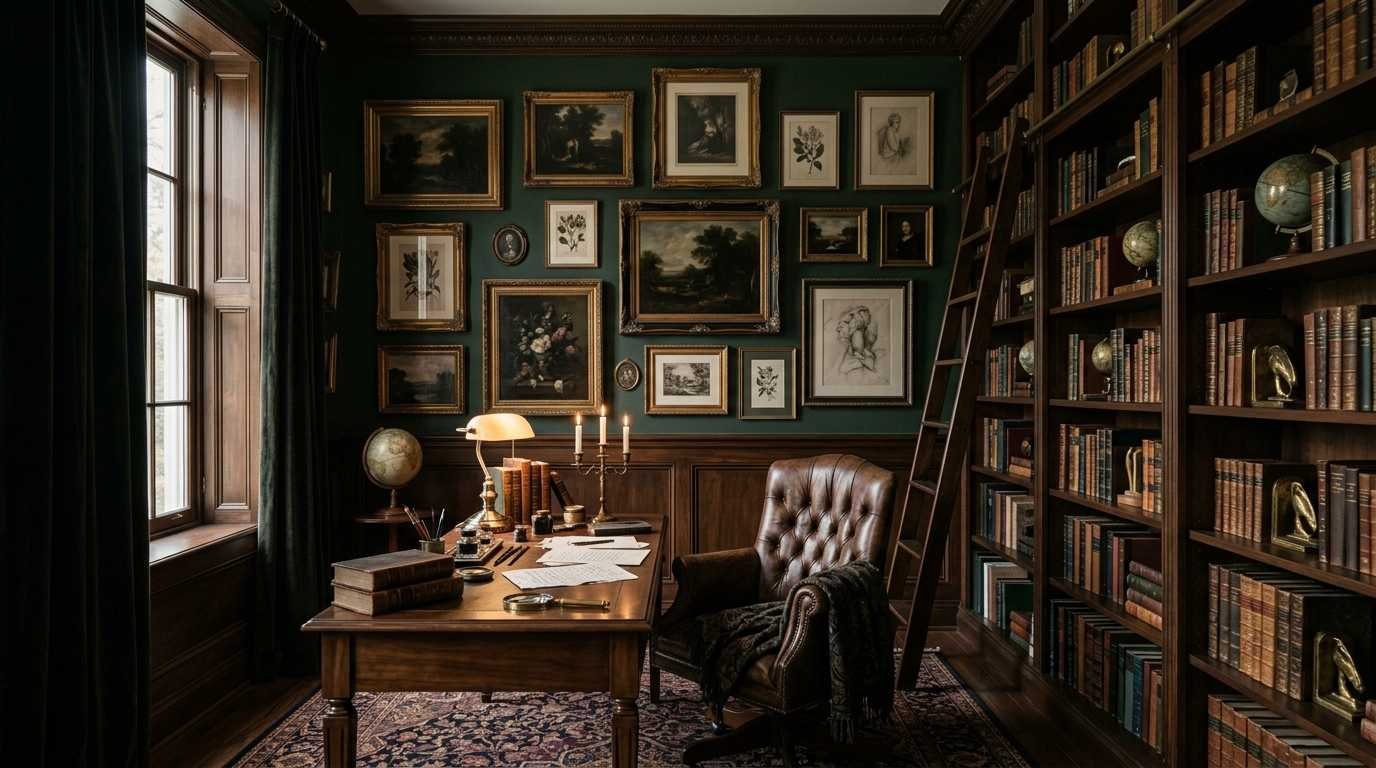

Dark academia decor transforms a room into a richly layered retreat inspired by old libraries, historic universities, classic literature, traditional architecture, and the quiet romance of intellectual life. The aesthetic favors deep colors, aged materials, antique-inspired furniture, books, artwork, warm lighting, and collected objects rather than perfectly coordinated contemporary interiors.
The appeal of dark academia lies in its atmosphere. We are not simply decorating with dark furniture or painting the walls brown. We are creating a space that feels as though it has accumulated stories over time. A reading chair beside a library wall, an old-fashioned desk beneath a brass lamp, framed botanical illustrations, and stacks of well-loved books can make even a modern room feel scholarly and timeless.
The style also works beautifully with existing interiors. We do not need an enormous library, historic house, or expensive collection of antiques. With thoughtful choices in color, texture, lighting, furniture, and accessories, we can introduce the character of dark academia into a bedroom, home office, living room, hallway, or small apartment.
Table of Contents
What Is Dark Academia Decor?
Dark academia decor is an interior style influenced by the visual language of classical education, literature, art, philosophy, architecture, and European university culture. It combines traditional interior design with moody colors and intellectual details.
Typical spaces feature:
- Dark wood furniture
- Leather or leather-look seating
- Antique-style desks
- Floor-to-ceiling bookshelves
- Vintage books
- Oil-painting-inspired artwork
- Brass or aged-metal accents
- Persian-style rugs
- Plaid and herringbone textiles
- Heavy curtains
- Warm table lamps
- Candlestick-style lighting
- Botanical and architectural prints
- Classical sculptures
- Framed maps
- Writing accessories
However, dark academia does not require every one of these elements. The strongest interiors usually feel collected rather than themed.
A room filled with books, dark furniture, and random vintage accessories can quickly become visually heavy. We get better results when each piece contributes to a coherent atmosphere.
Choose a Moody Dark Academia Color Palette
Color is one of the fastest ways to establish the mood.
The classic dark academia palette draws from forest green, oxblood, burgundy, chocolate brown, charcoal, navy, cream, and muted ochre. These shades create depth without making every surface completely black.
For walls, we can consider deep green, warm brown, charcoal gray, muted navy, or an aged cream. A darker ceiling can also work in rooms with sufficient natural light, creating a more intimate library-like atmosphere.
We should not assume that every dark academia room needs black walls. In fact, very dark walls can overwhelm a small room. A warm mushroom, taupe, tobacco, or muted olive can provide the same intellectual atmosphere while maintaining visual softness.
For a balanced palette, we can use approximately three layers:
- A dominant architectural color for walls or large surfaces.
- A darker secondary color through furniture and textiles.
- Warm accent colors such as burgundy, brass, rust, or ochre.
Cream and parchment tones are particularly useful because they prevent the room from becoming visually flat.
Use Dark Wood to Establish Character
Few materials communicate traditional academia as effectively as dark wood.
Walnut, mahogany-inspired finishes, oak stained in deep tones, and other richly colored woods work especially well for desks, bookcases, side tables, dining furniture, and bed frames.
An oversized modern desk can be replaced with a writing desk featuring drawers, turned legs, or a slightly aged finish. A contemporary bookshelf can be made more appropriate by filling it with books, framed artwork, ceramics, and small decorative objects rather than leaving large areas empty.
We should also embrace imperfections. A slightly distressed wooden surface can contribute more character than a perfectly polished reproduction.
If authentic antique furniture is outside the budget, we can combine affordable traditional pieces with one or two visually important vintage elements. This creates a layered appearance without requiring a complete furniture replacement.
Build a Dark Academia Bookshelf
Books are central to the aesthetic because they communicate the intellectual foundation behind the style.
A dark academia bookshelf should feel lived-in rather than showroom-perfect. We can arrange books both vertically and horizontally, leaving small spaces for artwork, framed photographs, sculptures, candles, or decorative objects.
Older-looking hardcovers are particularly effective. We can also incorporate dictionaries, literary collections, art books, philosophy books, travel books, and vintage encyclopedias.
For a more sophisticated arrangement, we can organize shelves according to height and visual weight rather than creating perfectly symmetrical rows.
A small stack of books beneath a brass lamp can be more effective than filling every surface with accessories.
Create a Scholarly Reading Corner
A reading corner gives dark academia decor a practical purpose.
We can begin with a comfortable armchair in leather, velvet, tweed, wool, or another textured material. Place it near a bookshelf or side table and add a warm reading lamp.
A small wooden table provides space for books, reading glasses, a notebook, or a cup of tea. A traditional floor lamp can provide additional illumination while reinforcing the vintage character.
The goal is to create a corner that feels inviting enough to use every day.
A reading corner does not need a large room. Even a narrow section beside a window can become a dark academia-inspired retreat with a chair, lamp, small table, and carefully selected artwork.
Layer Vintage-Inspired Artwork
Artwork plays an important role because empty walls can make the room feel unfinished.
Dark academia interiors work particularly well with:
- Classical portraiture
- Botanical illustrations
- Architectural drawings
- Antique maps
- Still-life paintings
- Landscape paintings
- Engravings
- Scientific illustrations
- Renaissance-inspired artwork
- Literary prints
Frames matter almost as much as the artwork itself. Dark wood, antique gold, bronze, and aged finishes generally work better than highly polished modern frames.
We can also create a gallery wall, but it should not look overly symmetrical. Combining different frame sizes and artwork styles can make the collection feel accumulated over decades.
Choose Lighting With a Warm Glow
Lighting can completely change the atmosphere of dark academia decor.
Bright, cool-white lighting tends to undermine the aesthetic. Instead, we should layer warm ambient, task, and accent lighting.
Table lamps with fabric shades, brass fixtures, traditional floor lamps, and wall sconces can create pools of warm illumination throughout the room.
A desk lamp is particularly important for a study or home office. It should provide enough focused light for reading and writing without flooding the entire room.
Candles can also contribute to the atmosphere when used safely. Even flameless candles can provide the visual warmth associated with traditional interiors.
The most effective approach is to avoid relying on one bright ceiling fixture. Multiple low-intensity light sources create greater depth.
Bring in Rich Textures
A successful dark academia room should feel tactile.
We can combine velvet, wool, leather, linen, cotton, wood, aged metal, stone, and woven materials. The contrast between these surfaces prevents the dark palette from becoming monotonous.
A Persian-inspired rug can introduce pattern and warmth beneath a wooden desk or seating area. Plaid cushions can add traditional character, while heavy curtains can make the room feel more established.
Herringbone, tweed, and subtle floral patterns are also excellent choices.
The key is moderation. Too many competing patterns can make the room feel theatrical rather than sophisticated.
Decorate With Brass and Aged Metals
Metal accents should reinforce the historical feeling of the room.
Brass, bronze, and aged metal work especially well for:
- Desk lamps
- Picture frames
- Drawer handles
- Candleholders
- Bookends
- Mirrors
- Decorative trays
- Curtain hardware
We should avoid making every metallic element identical. Slight variations in finish can make the room feel more naturally collected.
Add a Traditional Desk or Writing Area
The writing desk is one of the strongest pieces for a dark academia study.
A wooden desk with drawers immediately establishes the traditional character we want. On top, we can keep the arrangement functional: a notebook, fountain pen, desk lamp, small clock, book stack, and perhaps a decorative tray.
For a modern workspace, we can conceal cables and keep technology visually restrained. A laptop can remain part of the room without dominating the aesthetic.
This combination of modern functionality and traditional design is often more practical than trying to recreate an entirely historical study.
Use Mirrors to Reflect Light
Large dark rooms can sometimes feel smaller than they actually are. A strategically positioned mirror helps reflect natural and artificial light while adding architectural character.
Traditional rectangular mirrors, arched designs, and ornate frames can all work well.
In smaller spaces, a mirror opposite a window can make the room feel brighter without compromising the moody atmosphere.
Decorate With Maps, Globes, and Collected Objects
Decorative objects should tell a visual story.
A vintage-style globe, old map, magnifying glass, wooden box, ceramic vessel, antique clock, or small sculpture can reinforce the scholarly character.
But restraint is important. The room should not resemble a costume set.
We can select objects that genuinely interest us and distribute them naturally across shelves, desks, and side tables. Personal collections are more convincing than generic themed accessories.
Dark Academia Bedroom Ideas
The bedroom is particularly suited to this aesthetic because darker colors naturally create a restful, cocoon-like atmosphere.
A wooden bed frame can become the focal point. Layer it with neutral bedding, a wool throw, plaid cushions, and perhaps a darker accent blanket.
For the walls, deep green, muted navy, warm taupe, or chocolate tones can create an intimate backdrop.
Bedside tables with traditional lamps provide warm illumination, while framed artwork above the headboard adds visual interest.
We should keep the bedroom less cluttered than a study. Books, artwork, textiles, and lighting can establish the aesthetic without filling every surface.
Dark Academia Home Office Ideas
A home office is perhaps the most natural setting for dark academia decor.
A substantial wooden desk, comfortable chair, bookshelves, traditional lamp, and framed artwork can establish the look immediately.
We can organize the space around productivity rather than decoration. Keep frequently used items accessible while storing cables, chargers, and office supplies out of sight.
A large rug can visually define the workspace, particularly in an open-plan home.
For a modern office, a dark wood desk combined with a contemporary computer setup creates an appealing contrast between classic surroundings and modern technology.
Dark Academia Decor for Small Spaces
We do not need a large room to create the aesthetic.
In a small apartment, we can focus on a few high-impact elements:
- One dark accent wall
- A compact wooden desk
- A narrow bookshelf
- A vintage-style lamp
- One framed map or painting
- A patterned rug
- Several carefully selected books
Vertical storage is particularly useful. Tall shelving draws the eye upward while maximizing limited floor space.
We should also avoid oversized furniture. A smaller traditional writing desk can produce the desired atmosphere without consuming the entire room.
How to Make Dark Academia Feel Sophisticated
The difference between sophisticated dark academia and an overly themed room usually comes down to restraint and authenticity.
We should avoid buying dozens of objects simply because they have an antique appearance. Instead, we can combine old and new pieces.
A vintage wooden desk can sit beside a modern chair. Contemporary lighting can illuminate antique-inspired artwork. A modern sofa can work with a traditional rug and dark wood coffee table.
This contrast keeps the room relevant and comfortable.
The best interiors also leave some negative space. Not every shelf, wall, or tabletop needs decoration.
Affordable Ways to Create the Look
Dark academia does not have to be expensive.
We can begin with paint, secondhand furniture, books, textiles, and lighting.
Thrift stores, flea markets, estate sales, and secondhand marketplaces can be useful sources for wooden furniture and decorative objects. Older pieces often have the imperfections that make this style convincing.
Instead of purchasing an entire matching furniture set, we can gradually build the room.
A secondhand wooden desk, inexpensive warm-light table lamp, framed vintage-style print, patterned rug, and collection of books can transform a room surprisingly quickly.
Common Dark Academia Decorating Mistakes
One common mistake is making everything excessively dark. Without sufficient contrast, the room can become flat and oppressive.
Another mistake is relying too heavily on novelty decorations. A room filled with fake antique objects can look staged.
We should also avoid excessive clutter. Dark academia is layered, but it is not synonymous with mess.
Finally, we should consider comfort. Beautiful furniture that is uncomfortable will eventually become decorative rather than functional. A reading chair should invite reading, and a desk should support actual work.
Final Thoughts on Dark Academia Decor
Dark academia decor is ultimately about atmosphere, character, and thoughtful layering. Its strongest qualities come from the combination of traditional materials, scholarly references, warm lighting, rich colors, and objects that appear to have a history.
We can create the aesthetic in a grand library or a small apartment. The essential ingredients are not a huge budget or an authentic antique collection. They are intentional choices: a darker palette, natural materials, meaningful books, comfortable furniture, warm illumination, and artwork with personality.
When we approach the style as an interior philosophy rather than a strict decorating formula, it becomes much more versatile. A modern home can borrow its warmth. A traditional room can deepen its character. A small workspace can gain atmosphere.
The result should feel quiet, intelligent, collected, and deeply personal—a space that encourages reading, reflection, creativity, and slow living rather than simply looking fashionable for a season.


Leave a Reply