


A tatami mattress offers a distinctive approach to sleeping that combines the simplicity of Japanese floor bedding with practical benefits for modern homes. Unlike a conventional bed setup, this style places sleeping closer to the floor and emphasizes a compact, flexible arrangement that can be folded, stored, or combined with traditional tatami surfaces.
As interest in minimalist interiors, Japanese-inspired bedrooms, and space-efficient furniture continues to grow, Japanese tatami mattresses have become increasingly popular outside Japan. They can work particularly well in guest rooms, small apartments, multipurpose bedrooms, and homes designed around a calm, uncluttered aesthetic.
However, the terminology can be confusing. A tatami mat, a futon mattress, and a tatami mattress are not necessarily the same thing. Understanding those differences is important before choosing a sleeping system.
Table of Contents
What Is a Tatami Mattress?
A tatami mattress is a relatively thin sleeping mattress designed for use on or close to the floor, often as part of a Japanese-inspired bedding system. Depending on the design, it may be made from cotton, polyester, foam, latex, wool, or combinations of these materials.
Traditional Japanese sleeping arrangements commonly use a futon mattress, known as a shikibuton, placed on a tatami floor. The tatami itself is a firm flooring surface traditionally constructed with a woven rush covering over a supportive core.
Modern manufacturers sometimes use the phrase “tatami mattress” to describe a floor mattress intended to recreate some of the characteristics of this setup.
The distinction matters because tatami is traditionally a floor covering, not simply a mattress. A shikibuton provides the sleeping surface, while tatami provides the underlying support and ventilation characteristics.
Modern products marketed as tatami mattresses can therefore vary substantially in construction and purpose.
Japanese Tatami Mattress vs. Traditional Futon
A Japanese tatami mattress and a traditional Japanese futon are related but should not automatically be treated as identical.
A traditional shikibuton is a sleeping mattress that can generally be folded and stored during the day. It is commonly used with a kakebuton, or Japanese comforter, and traditionally rests over tatami.
A tatami mat, meanwhile, creates a firm and resilient foundation.
The modern interpretation may combine elements of both concepts. Some floor mattresses are designed to be used directly on hardwood or other flooring, while others are specifically intended to sit on tatami mats, platform beds, or low-profile frames.
When shopping, we recommend checking the manufacturer’s intended use rather than relying solely on product terminology.
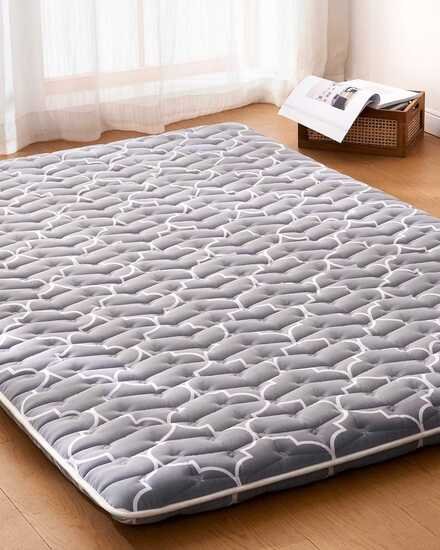
Tatami Mattress and Tatami Mat: What Is the Difference?
The simplest distinction is this:
- Tatami mat: A traditional Japanese flooring surface.
- Futon mattress: A sleeping mattress traditionally placed over tatami.
- Tatami mattress: A modern term that may describe a Japanese-style floor mattress or mattress designed for use with tatami.
- Tatami floor mattress: A broader modern category of low-profile mattresses intended for floor sleeping.
This distinction becomes especially important when evaluating thickness.
A traditional shikibuton is relatively thin compared with many Western mattresses. A modern floor mattress may be substantially thicker because it uses foam or other cushioning materials.
Tatami Floor Mattress for Modern Homes
A tatami floor mattress can be particularly useful where flexibility matters more than a permanent bedroom arrangement.
For example, a compact bedroom might use a foldable mattress at night and return to an open floor during the day. A guest room can serve as an office, reading room, or exercise space when nobody is staying overnight.
This flexibility is one of the strongest arguments for floor sleeping.
The arrangement also complements minimalist interiors. Instead of a large bed frame, headboard, nightstands, and bulky furniture dominating the room, a low sleeping arrangement leaves more visible floor area.
That can make a small room feel visually calmer and more spacious.
Why Choose a Japanese Floor Mattress?
There are several reasons we may consider a Japanese floor mattress for a bedroom.
Space Efficiency
A foldable mattress can be stored vertically or folded when it is not needed. This makes it attractive for apartments, studio spaces, guest bedrooms, and multipurpose rooms.
Minimalist Design
The low profile naturally complements Japanese, Japandi, Scandinavian, and minimalist interiors.
Flexible Sleeping Arrangement
A floor mattress does not require a permanent bed frame. We can create a sleeping area when needed and reclaim the room afterward.
Firm Sleeping Surface
Many Japanese-style floor mattresses provide a firmer feel than plush Western mattresses. For sleepers who prefer substantial support, this can be appealing.
Simple Bedroom Aesthetic
A low mattress, natural textile bedding, neutral colors, and an uncluttered room can create a peaceful visual environment.
Choosing the Right Tatami Mattress
Not every tatami-style mattress will provide the same experience. We should evaluate several factors before purchasing.
Thickness
Thickness affects cushioning, portability, and support.
Very thin mattresses are lightweight and easy to fold, but they provide less separation between the sleeper and the floor. Thicker models can provide additional cushioning but may be heavier and more difficult to store.
Rather than choosing the thickest available option, we should consider our sleeping position, body weight, flooring surface, and preferred firmness.
Materials
Common materials include cotton, polyester, foam, latex, and layered combinations.
Natural fibers can provide a traditional feel, while foam constructions may offer more consistent cushioning. Latex can provide resilience and a responsive feel.
The quality of the internal construction is more important than simply choosing a material because two mattresses made from the same general material can feel completely different.
Firmness
Floor sleeping generally works best with a supportive surface rather than an extremely soft one.
A mattress that compresses excessively can reduce the benefits of a firm sleeping arrangement and may also make getting up more difficult.
Portability
If the mattress will be folded and stored every day, weight and folding design become important.
A mattress that looks attractive but is cumbersome to move can quickly become impractical.
Foldable Tatami Mattress: Is It Worth Choosing?
A foldable tatami mattress is one of the most practical choices for small spaces.
Folding allows us to remove the sleeping surface from the room when it is not required. Some designs fold into thirds, while others roll for storage.
The ideal configuration depends on available storage.
A tri-fold design can be convenient for closets and compact storage areas, while a roll-up mattress may occupy less floor space when stored.
We should also pay attention to the folded dimensions rather than only the mattress dimensions when unfolded.
Can You Put a Mattress on a Tatami Mat?
Yes, a mattress can generally be placed on a tatami mat, but the suitability depends on the mattress design.
A conventional thick Western mattress may not be appropriate for traditional tatami flooring because it can interfere with ventilation and may be too heavy for convenient movement.
A thinner Japanese-style mattress or shikibuton is usually more compatible with the traditional concept.
The important consideration is airflow.
When any mattress remains directly against a surface for extended periods, moisture can accumulate underneath. Regular airing, lifting, rotating, and cleaning can help reduce this problem.
How to Clean a Tatami Mattress
Knowing how to clean a tatami mattress is essential because floor sleeping exposes bedding to dust and moisture from the surrounding environment.
We should always follow the manufacturer’s cleaning instructions first.
For a washable cover, remove the cover and clean it according to its care label. For the mattress itself, vacuuming with an appropriate upholstery attachment can help remove surface dust.
If a small spill occurs, blot rather than aggressively rubbing the affected area. Excess moisture should be avoided unless the mattress is specifically designed to be washed.
A floor mattress should also be aired regularly.
If the mattress is placed on tatami, the tatami surface should be maintained separately. Traditional tatami requires different care from fabric or foam mattresses.
How to Wash a Tatami Mattress
The question of how to wash a tatami mattress depends entirely on its construction.
Some modern mattresses have removable, machine-washable covers. Others should never be saturated with water.
We should never assume that a floor mattress can be placed inside a washing machine simply because it is relatively thin.
Before washing, check:
- The manufacturer’s care label.
- Whether the cover is removable.
- Whether the internal filling is washable.
- Recommended water temperature.
- Drying requirements.
- Whether professional cleaning is recommended.
Complete drying is particularly important. Storing a damp mattress can create unpleasant odors and encourage moisture-related problems.
Tatami Mattress Maintenance
Regular maintenance can significantly extend the useful life of a floor mattress.
We recommend:
- Air the mattress regularly.
- Rotate it periodically to distribute wear.
- Vacuum the surface according to the manufacturer’s instructions.
- Keep the floor underneath clean and dry.
- Avoid trapping moisture between the mattress and floor.
- Use a breathable cover when appropriate.
- Follow the manufacturer’s cleaning instructions.
If the mattress is folded for storage, it should be clean and completely dry before being put away.
Tatami Mattress for Small Bedrooms
Small bedrooms are one of the strongest use cases for this style of bedding.
A conventional bed can consume a large percentage of the available floor area. A floor mattress can effectively transform the room between daytime and nighttime use.
For a studio apartment, for example, the same floor area could function as a living space during the day and a bedroom at night.
This approach works particularly well when paired with low-profile furniture, concealed storage, neutral textiles, and simple lighting.
The result is not simply a smaller bedroom. It can become a more flexible room.
Tatami Mattress vs. Western Mattress
The two systems reflect different approaches to bedroom design.
A conventional Western mattress is normally used with a bed frame and is often considerably thicker. A Japanese-inspired floor arrangement prioritizes a lower profile, portability, and flexible use of space.
Neither system is universally better.
A floor mattress may appeal to people who value minimalism and compact living. A traditional mattress may be preferable for someone who wants a raised sleeping surface, substantial cushioning, or easier access at standing height.
Personal comfort should ultimately determine the choice.
Is a Tatami Mattress Good for Everyone?
No sleeping surface is ideal for every sleeper.
People who prefer a very soft mattress may find a traditional Japanese-style floor setup too firm. Others may appreciate the stable, supportive sensation.
We should also consider accessibility. Getting down to and up from a floor mattress can be more demanding than using a raised bed.
Room temperature and flooring are relevant as well. A floor sleeping arrangement can feel cooler because the sleeper is closer to the floor.
For these reasons, choosing a tatami mattress should involve more than aesthetics.
Creating a Stylish Japanese-Inspired Bedroom
A tatami mattress can become the foundation of a sophisticated Japanese-inspired bedroom without making the space feel overly themed.
We can combine:
- Natural wood
- Neutral bedding
- Linen or cotton textiles
- Low-profile furniture
- Soft ambient lighting
- Simple ceramics
- Woven storage
- Natural textures
- Minimal decorative objects
The goal is restraint.
A successful Japanese-inspired bedroom does not need dozens of traditional objects. Instead, the aesthetic comes from proportion, material, texture, negative space, and careful organization.
This is also why a tatami floor mattress can work beautifully in a contemporary Japandi interior.
Tatami Mattress Buying Checklist
Before purchasing, we should evaluate the following:
1. Intended surface: Will it be used on tatami, wood, carpet, or another floor?
2. Mattress thickness: Does the thickness provide the desired balance of support and cushioning?
3. Dimensions: Does it fit the sleeping space without restricting movement?
4. Materials: Are the filling and cover appropriate for the intended climate and maintenance routine?
5. Storage: Can it be folded or rolled conveniently?
6. Ventilation: Can air circulate around the mattress when it is stored or used?
7. Cleaning: Is the cover removable and washable?
8. Firmness: Does the construction suit the sleeper’s preferred feel?
9. Weight: Can it realistically be moved regularly?
10. Manufacturer instructions: Are the care and usage recommendations clear?
Final Thoughts on Tatami Mattresses
A tatami mattress represents more than an alternative to a conventional bed. It offers a different philosophy of bedroom design—one based on flexibility, simplicity, efficient use of space, and a closer relationship with the room itself.
For modern homes, the concept can be adapted in many ways. A Japanese tatami mattress can complement a minimalist bedroom, while a foldable tatami mattress can transform a multipurpose room. A tatami floor mattress can also provide a practical sleeping solution where a permanent bed would take up too much space.
The most important distinction is understanding what we are actually buying. Traditional tatami mats, shikibuton mattresses, and modern floor mattresses serve different functions, even though retailers may sometimes use overlapping terminology.
With the right construction, appropriate firmness, regular airing, and careful maintenance, a Japanese-inspired floor sleeping arrangement can be both practical and visually refined. For anyone drawn to minimalist interiors and flexible living, it offers a compelling way to rethink what a bedroom needs—and what it can do without.



Leave a Reply